Historically associated with the public sector, the concept of conflicts of interest concerns all stakeholders, both public and private. Whatever their activity, all organisations may suffer the serious consequences of a conflict of interest. By damaging reputation and stakeholder trust, it threatens budgetary balance and the long-term viability of the company, local authority, or public administration.
Preventing conflicts of interest is one of the essential pillars of an effective risk management and anti-corruption policy. Values Associates provides you with the keys to fully understand the issue and implement best practices.

A conflict of interest represents a major risk for a company, local authority, or public administration. Its consequences—financial, economic, commercial, or reputational—are severe, with long-term repercussions that are difficult to remedy.
A decision driven by personal interest is rarely the most optimal for the company, local authority, or public administration. A supplier selected for personal reasons may be more expensive than a competitor or offer lower service quality.
Similarly, an employee or agent hired due to family ties may lack the skills required for the role.
Thus, a choice based on subjective criteria can jeopardise a project, impair the organisation’s financial results, unbalance its budget, and even threaten its competitiveness and performance.
A conflict of interest is not a criminal offence. However, it is a source of criminal offences, severely punished by law. Financial penalties jeopardise the budgetary balance of the company, local authority, or public administration.
For example, any person found guilty of private-sector corruption faces up to five years’ imprisonment and a €500,000 fine. In the public sector, the sentence is doubled. And for legal entities, the fine is multiplied by five. Other offences are also punished by substantial fines.
In the public sector, unlawful taking of interests is punishable by five years’ imprisonment and a €500,000 fine, and the offence of favouritism by two years’ imprisonment and a €200,000 fine.
A proven conflict of interest, accompanied by legal proceedings, damages the image and reputation of the company, local authority, or public administration.
By calling the organisation’s transparency and integrity into question, a conflict of interest breaks the bond of trust with stakeholders (partners, investors, public officials, employees, customers, users, citizens, suppliers, etc.). Easy to lose but slow to regain, trust is a foundation whose loss endangers the organisation. The economic risk is real, with declining sales, partnership breakdowns, or financial disengagement.
In the public sphere, a conflict of interest undermines citizens’ fragile trust in institutions, affecting the legitimacy and effectiveness of public policies.
The legal definition of a conflict of interest in France is recent. It dates from 2013 and primarily concerns the public sector, where ethical and professional conduct rules are regulated.
The OECD provided a definition of conflicts of interest in the public sector as early as 2006. In France, it was not until 2013 and the law on transparency in public life that conflicts of interest were defined.
According to Article 2, “a conflict of interest is any situation of interference between a public interest and public or private interests that is likely to influence, or appear to influence, the independent, impartial and objective exercise of a function.”
This definition can be extended to businesses. In practical terms, a conflict of interest exists when the personal interest of an executive, director, elected official or employee conflicts with the organisation’s interest, disrupting the performance of their professional duties and compromising their ability to act and make decisions in an impartial, objective and independent manner.
The concept of personal interest is broad. It may be direct or indirect, and provide an advantage to the person or a member of their close circle. It may be material or moral, linked to the ownership of tangible or financial assets, or linked to other professional or voluntary activities.
A conflict of interest can take several forms punishable by law, such as unlawful taking of interests, revolving doors, the offence of favouritism, or influence peddling.
Although conflicts of interest originated legally in the public sphere, this is not without reason. It stems from the 1983 law on the rights and obligations of civil servants. These principles were reaffirmed in 2016 by the law on the professional conduct of civil servants.
These laws set out the foundational ethical principles of the civil service, including integrity, neutrality, impartiality and equality of all before the public service. In the service of the public interest, public officials have an ethical duty of exemplary conduct and loyalty.
While the principles of loyalty and ethics are not explicitly set out in law for the private sector, they are reiterated in codes of ethics. Linked to a profession or a company, the code of ethics describes the rights, duties and ethical behaviours to adopt in professional activities. This is also the purpose of the internal code of conduct. As an anti-corruption tool, its requirements can be extended to conflicts of interest.
Dans la fonction publique, de nombreux élus et agents sont concernés par le risque de conflits d’intérêts. Les activités les plus propices aux conflits d’intérêts sont :

D’un point de vue très opérationnel, deux fonctions sont particulièrement vulnérables aux conflits d’intérêt : l’achat de biens et de services et le recrutement. Tout lien personnel peut menacer la neutralité et l’équité des processus, souvent moins encadrés que dans la fonction publique.
La politique parrainage et mécénat ouvre aussi une brèche au conflit d’intérêts. C’est le cas par exemple si un entrepreneur est tenté de parrainer l’équipe de football local dans laquelle joue son fils, au détriment d’autres équipes ayant sollicité l’entreprise.
La fonction stratégique et financière est aussi très sensible au conflit d’intérêts. Des intérêts personnels peuvent guider des décisions d’investissements, de rachats d’entreprises, de prise d’actions dans d’autres sociétés ou de fusions-acquisitions.
To avoid the serious consequences of a conflict of interest, the organisation must always remain vigilant.
The challenge? Identifying potential and apparent conflicts of interest before they become actual.
without clear justification and based on questionable criteria.
between an elected official, executive, director or employee and a partner of the organisation (business partner, financial partner, supplier, etc.).
for example, if an individual uses the resources of the company, local authority or public administration for personal activities.
The most common mistake is to turn a blind eye to apparent and potential conflicts of interest. Not immediately proven, these conflicts of interest may be considered secondary by the organisation. Yet no risk should be overlooked. In the age of social media, any conflict of interest can quickly damage the reputation of the company, local authority or public administration.
Other mistakes and oversights encourage conflicts of interest, such as:
➡️ Encouraging opaque decision-making by delegating it to a single employee, with no managerial oversight or requirement to justify decisions.
➡️ Tolerating the overlap of professional and personal activities, by allowing an employee or agent to use the organisation’s resources for private purposes.
➡️ Being lenient about declaring personal interests, particularly for roles identified as sensitive.

Two major laws govern conflicts of interest in the civil service. The private sector has little in this area, with a few targeted texts covering specific activities and professions.
Focused on senior public officials and civil servants, the 2013 law on transparency in public life:
The professional conduct law of 20 April 2016 targets public officials. It:
There is no overarching law governing conflicts of interest in companies.
However, certain laws or provisions of the Commercial Code set out procedures for preventing and managing conflicts of interest, targeted at specific activities, professions or sensitive roles (healthcare, pharmaceuticals, statutory auditors, lawyers, real estate agents, etc.).
Effective since 2017, the Sapin 2 law aims to combat corruption in companies and public institutions. Although conflicts of interest are not its primary focus, the Sapin 2 law addresses them indirectly. Conflicts of interest create a risk of corruption. One cannot be addressed effectively without addressing the other.
The Sapin 2 law is an opportunity to formalise a policy for preventing and managing conflicts of interest. These can be easily included in the tools required by the Sapin 2 law, including risk mapping, the internal code of conduct, the whistleblowing procedure, third-party assessment, or the definition of a sanctions regime.
Preventing and managing conflicts of interest is difficult, as situations are numerous and varied. Everyone has external ties, whether family, friends, professional or community ties. To be effective, the prevention and management of conflicts of interest require clear and transparent processes, which digital tools can help secure.
The prevention and management of conflicts of interest is aligned with other internal risk management policies (anti-corruption policy, gifts and hospitality policy, sponsorship and patronage policy, etc.). An effective policy follows several steps:
This requires identifying the most sensitive roles and processes and fostering an environment that encourages the reporting of conflicts of interest.
The organisation can incorporate the identification of conflicts of interest into risk management tools, such as risk mapping and third-party risk assessment.
Define and implement an internal policy for managing conflicts of interest: prevention and remediation measures may include mandatory declarations of personal interests and assets (targeted at the most sensitive roles or extended to all), oversight of decisions (managerial control, collective decision-making), self-reporting, automatic recusal from a procedure for an employee concerned by a personal interest, appointing an ethics officer, etc.
Raise awareness and train elected officials, executives, directors and employees, particularly those in sensitive roles.
Define a clear disciplinary sanctions regime that is proportionate to the misconduct.
The diversity and number of conflict-of-interest risks make their prevention and management more complex for the company, local authority or organisation.
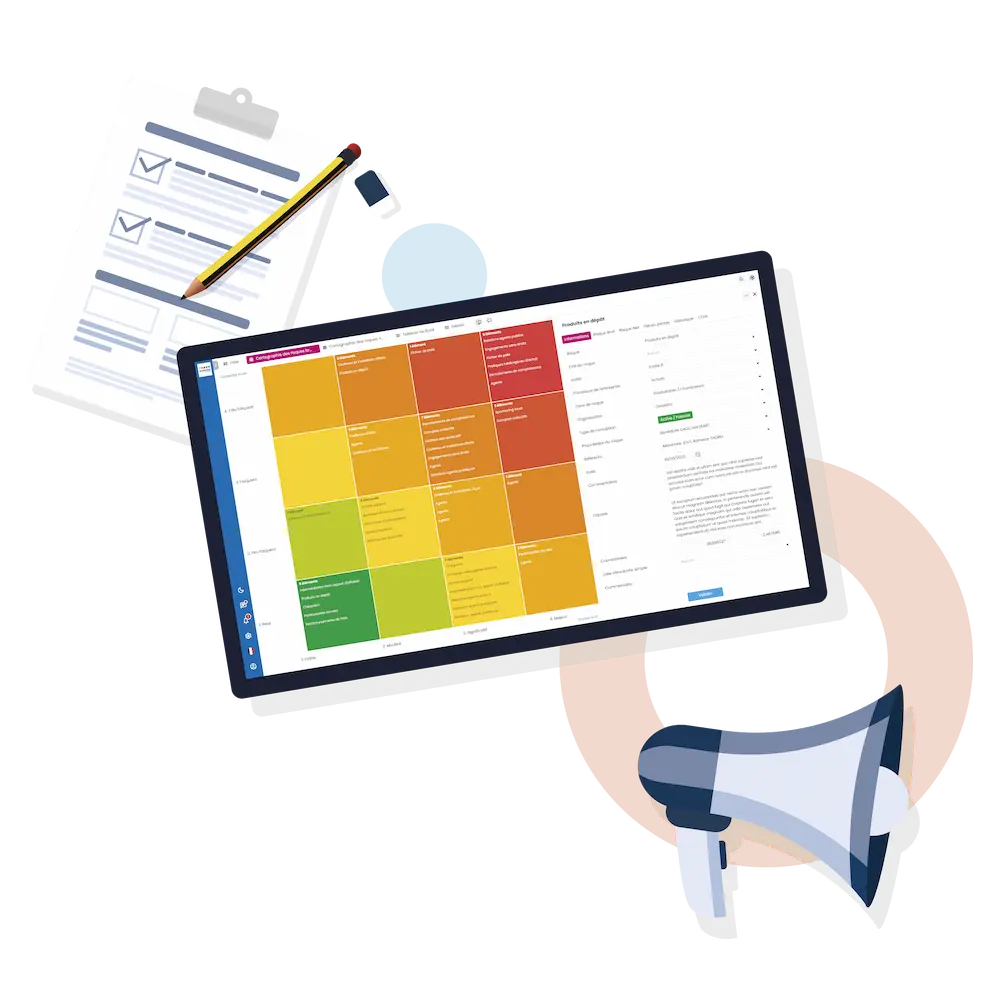
Using digital tools simplifies, facilitates and secures procedures. For example, based on the data entered, software can analyse relationships between stakeholders, detect potential conflicts and alert responsible parties before a situation escalates.
A digital tool can also host and secure the conflicts of interest register. It simplifies the declaration of interests via an online form with customised fields (list of past and current professional and voluntary activities, spouse’s profession, financial interests, etc.). It protects personal data in compliance with the GDPR.
Using software dedicated to managing conflicts of interest also facilitates data collection through self-reporting. In just a few minutes, elected officials, executives, directors and employees can answer a list of questions and assess the risk of a conflict of interest in a given situation (“Am I, or is someone close to me, likely to benefit from one of my decisions or actions?”, “Do I currently have, or have I had in the past, personal or professional relationships with one of the parties?”, etc.).
Conflicts of interest are a major risk for public and private organisations. They affect reputation, destroy trust, and undermine finances. By prioritising personal interest, they harm the collective interest and threaten the organisation’s long-term viability. Proactive management of conflicts of interest, based on clear processes, a robust awareness and training programme, and effective digital tools, is key to ensuring transparent and ethical decisions and protecting the interests of the company, local authority or public administration.