
For risk professionals, risk mapping is a crucial step and an essential tool for identifying, assessing, and prioritizing the risks to which an organization is exposed and organizing the various action plans to be implemented.
We invite you to explore the different facets of risk mapping and provide you with a step-by-step guide to implementing this method within your organization. We also propose to examine why and how to digitalize your risk mapping process.
Risk mapping covers all the steps involved in identifying, assessing, and graphically representing the risks that a company or public sector organization may face.
Risk mapping relies upstream on the analysis of potential risks for the organization. This phase of work enables the creation of a risk inventory, including their nature and characteristics.
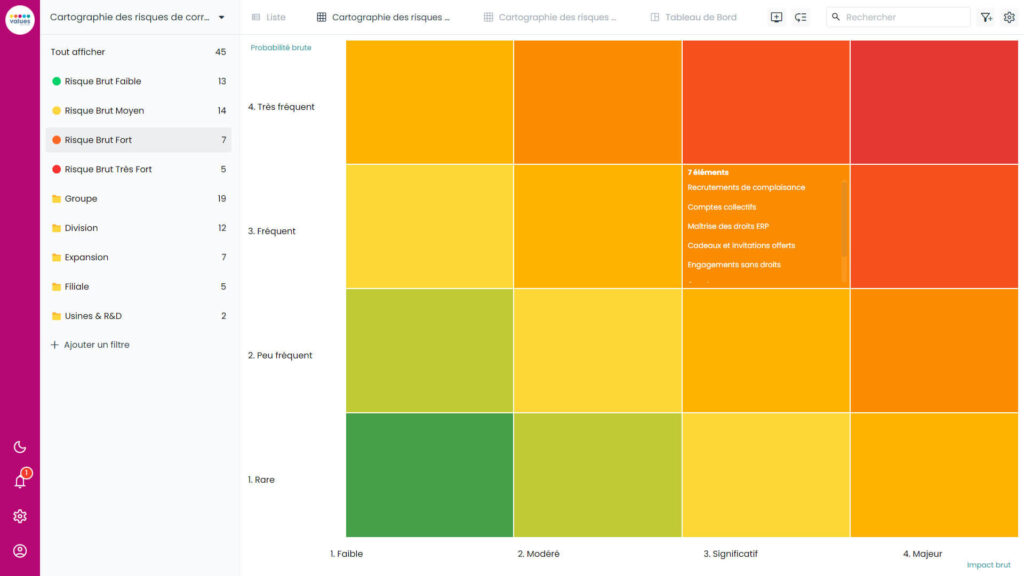
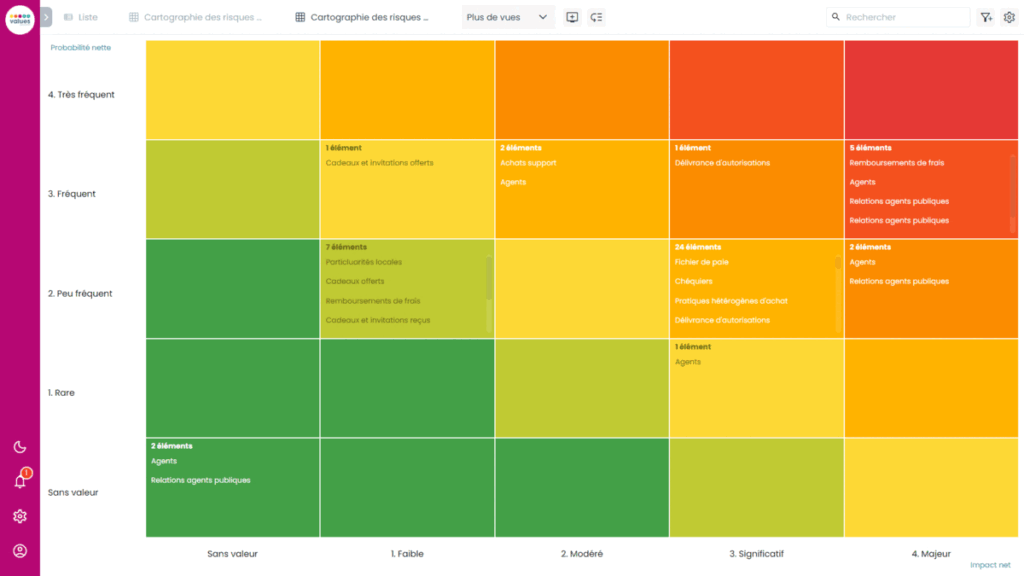
These risks are also assessed according to two main criteria: their probability of occurrence on the one hand, and their impact on the organization on the other, with concepts of gross risk and net risk, depending on the nature of the risk control measures implemented or to be implemented.
This essential assessment step thus enables risks to be prioritized according to their criticality for the organization.

The risk mapping process has the great advantage of establishing in a highly formalized manner a thorough understanding of the risks the organization faces.
By documenting and facilitating the visualization of risks and their interconnections, risk management professionals are able to communicate and interact with stakeholders regarding the nature of risks, their causes and impacts, the factors contributing to their occurrence and severity, as well as the associated action plans in terms of risk management.
This work of exchanges and iterations during the different stages of developing the risk map ultimately optimizes resource allocation and the relevance of risk management measures implemented or to be implemented within the organization.
By fostering communication and collaboration among the organization’s various stakeholders, the risk mapping approach is a strong lever for shared understanding, buy-in, and commitment.

The different risks an organization may face are generally structured according to their nature. The risk mapping exercise thus relies almost systematically on the following main risk categories:
These risks are related to the organization’s processes, to the procedures and controls associated with systems. They may, for example, result from human errors, breakdowns, supply chain disruptions, etc.
These risks are related to the operations and financial management of the company or public sector organization. They may notably result from developments in financial markets, currency fluctuations (exchange rates, interest rates, access to credit, liquidity, etc.).
These risks concern strategic decisions made by the company or public sector organization. These may include, for example, positioning decisions, growth operations, mergers and acquisitions, investments, and technology choices.
These are risks related to non-compliance with applicable laws, regulations, and standards impacting the sector or jurisdiction in which the company or public sector organization operates.
These risks result from events or actions that could damage the reputation, image, and standing of the company or public sector organization. These may include litigation or scandals involving the organization.
These risks are related to the IT security of the company or public sector organization and include cyberattacks, data theft, hacking, and privacy violations.
These risks are related to dependence on external suppliers and partners. Issues such as raw material shortages, delivery delays, or supplier failures can impact operations.
Environmental risks include issues related particularly to climate change, natural disasters, and environmental regulations.
These risks encompass challenges related to personnel management, such as talent retention, labor disputes, occupational health and safety issues, etc.
Increasingly impactful, these risks particularly include geopolitical developments and tensions, global economic fluctuations, and financial crises.
Several main steps structure the work of developing and updating a risk map.
The risk mapping process begins with the identification of potential risks. This step is generally carried out by relying on the collection and review of market data, organization-specific data, by conducting interviews with stakeholders, and by using different risk analysis approaches (root cause analysis, scenario analysis, etc.).
Each identified risk is then assessed and weighted according to two main variables: the level of impact of the risk on the company or public sector organization and its probability of occurrence.
This assessment is structured around two complementary concepts: gross risk assessment and net risk assessment (taking into account the risk control measures implemented or to be implemented).
The risks thus assessed are then ranked according to their level of criticality for the organization, enabling the definition of associated measures and actions.
The company or public sector organization is ultimately able to position itself according to acceptability and exposure limits for each risk and to define on this basis the plan of specific measures to be implemented to limit the criticality level of each identified risk.
The implementation of a periodic review and update process ensures that the risk map remains relevant and effective for the entire risk management system implemented in the organization. This process thus enables the integration and consideration of various developments in the company's or public sector organization's internal and external environment.
The different risks an organization may face are generally structured according to their nature. The risk mapping exercise thus relies almost systematically on the following main risk categories:
As we have seen, risk identification and understanding involves collecting, integrating, and analyzing a large amount of data. The ultimate objective is to obtain both an overview and a detailed view of the threats that may impact the company or public sector organization. This identification and understanding phase is not limited to simply creating a list of risks. It also includes the collection and processing of information to qualify the nature, origin, impact, probability, and interactions between risks. The exercise relies particularly on data from various sources, covering all activities and processes within the organization.
The integration and analysis of this information on a centralized platform can particularly facilitate the identification of duplicates and provide a global and coherent view.
Data visualization is one of the notable trends in recent years in data exploitation.
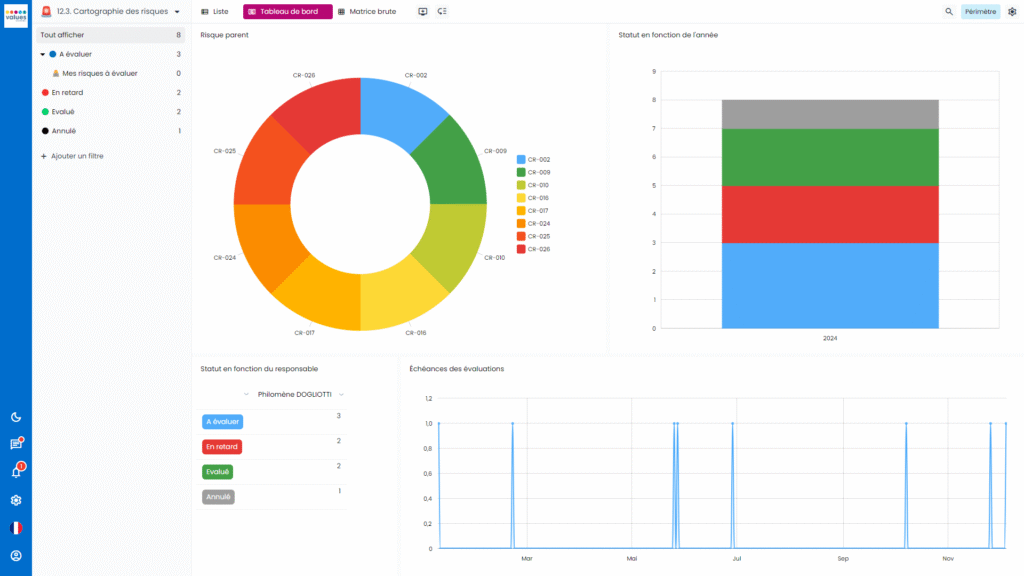
With now a very wide range of visualizations, from the most classic to the most original, it becomes easier to manipulate, analyze, and present data from the work carried out as part of the risk mapping exercise: data aggregation, zooming in and out, interactive tracking over time—data visualization goes beyond static representations of traditional tables and graphical presentations by offering both dynamic and interactive presentation functionalities. Through the manipulation of sliders or filters, for example, it becomes easy to identify and zoom in on specific elements and foster an immersive experience.
Given the particularly strategic nature of risk mapping for the company or public sector organization, the security of associated data and reliable access rights management constitute two prerequisites.
By nature, the risk mapping process requires working with sensitive and confidential data. The implementation of a system making unauthorized access and data leaks difficult is essential to ensure information protection.
The automation of alerts and notifications, to signal for example a task to be performed, a task coming due or overdue, is essential. This automation ensures a more proactive and efficient approach to the different stages of risk mapping. Automatic reminders thus reduce the risk of forgetting or delaying the completion of an action to be taken. They help maintain surveillance over the completion of different tasks. This is a strong lever to ensure compliance with the overall schedule of work for the entire risk mapping process.
These notifications also strengthen collaboration among the different stakeholders in the risk mapping exercise by alerting each relevant contributor as soon as a task requires action on their part (communication or validation of information, for example).
Sharing and collaboration among different stakeholders play a central role in the risk mapping process. Without this, it is impossible to benefit from a comprehensive view.
It is by relying on the expertise and insights of each person that it will be possible, on the contrary, to build a complete overview of the risks that may impact the organization. By collaborating, contributors can exchange and compare their views and positions on different risk scenarios, probabilities, and impacts. This is all the more critical as certain risks may be interconnected. These opportunities for exchanges and debates contribute to enriching the quality of analyses and achieving a more refined assessment of risks and action plans associated with the risk mapping exercise.
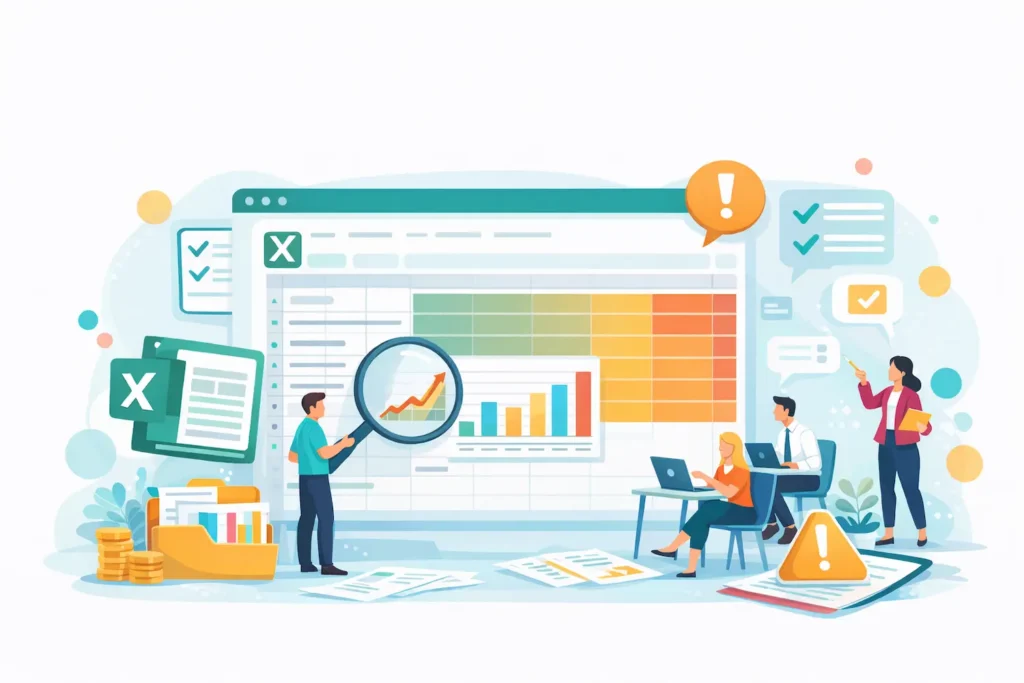
Excel is by nature one of the tools most spontaneously used in a risk mapping process. Many risk mapping templates are available, including free ones. Excel is indeed generally used by all stakeholders within organizations, companies, or public sector organizations. Due to its flexibility, it allows strong customization to the specificities of each organization. It thus facilitates data collection. With a minimum of expertise in handling this tool, it is also easy to structure and represent collected data in the form of a risk matrix.
However, Excel is not ideal for collecting and especially consolidating a large amount of data. Handling sources from different contributors multiplies the risks of error as well as time-consuming tasks. Excel also does not manage follow-up activities and is not a tool enabling collaboration. It also quickly becomes very tedious and time-consuming to update a risk map developed in Excel over the years: each desired change often requires extensive work due to the complexity of the Excel developments carried out, particularly in the form of macro formulas.
As with Excel, developing a risk map with a digital application generally offers broad customization functionalities. It is thus easy to organize and contextualize risk rating and assessment methods, to customize the fields intended to characterize and describe different risks. Drag-and-drop functionalities simplify these customization activities. Applications developed with a “no-code” approach make customization work particularly fast.
However, one of the decisive advantages of a digital risk mapping application is to optimize collaboration. Being able to work on a centralized and shared environment, providing everyone with updated information in real time. Contributor involvement is facilitated by automated task assignment and notification management. This approach reduces time-consuming tasks. It has the great advantage of also strengthening communication among different stakeholders and everyone’s commitment.
A final advantage: a digital risk mapping application generally offers extensive traceability functionalities: actions performed by each contributor are recorded and can be presented in the form of audit trails. Furthermore, confidentiality issues, which are critical in risk mapping, are also ensured through rights and access management.
To implement an effective risk mapping system, it can be useful to rely on a few standard prerequisites.
The involvement of relevant stakeholders remains essential in the risk mapping process, which is by nature highly cross-functional. Their participation ensures the quality of insights and information provided, a shared understanding of risks, as well as buy-in and commitment around the organization’s risk management strategy.
The risk mapping process should also be as flexible and scalable as possible. Risks are constantly evolving. It is therefore crucial to ensure periodic updating and adjustment of the risk map, to identify and integrate elements and changes in the organization’s internal or external environment. The implementation of a regular review process ensures that the risk map remains relevant and effective for the organization’s entire risk management system.
Values Associates has developed software dedicated to your risk mapping for companies and public sector organizations.
Discover our software and request a demo.
A risk map is generally developed in four main steps. It begins with the identification of risks for the organization.
These risks are then assessed based on their impact and probability, then prioritized according to their criticality in order to define an associated action plan.
Final step: regular updating and revision of the risk map to integrate internal and external developments that may impact the organization.
Excel is very frequently used to build a risk map, particularly due to its flexibility and the fact that it is widely used within organizations. Many free risk mapping templates are thus available online and can be customized.
However, Excel does not facilitate collaborative work and is not suitable for processing numerous data sources. Furthermore, updating the risk map can become tedious due to the complexity of the developments carried out.
Risk mapping formalizes the understanding of an organization’s risks. By identifying risks, their connections, causes, and impacts, and then enabling prioritization of these risks, this approach optimizes resource allocation and the organization’s risk management measures.
The creation of risk mapping within an organization relies by nature on all contributors who can provide insights on different activities and different types of risks that may impact the organization (operational, financial, regulatory risks, etc.).
The participation and contribution of different stakeholders are essential to obtain a comprehensive and relevant view of the risks to which the company or public sector organization is exposed.
Apart from certain business sectors or regulations, creating a risk map is not mandatory.
However, its value lies in enabling a proactive approach to risks and optimizing the organization’s resource allocation. This is all the more necessary in an environment where risks are multiplying and their impacts can be critical for the organization’s growth.
Updating a risk map relies on identifying changes in the organization’s environment (internal or external).
The objective in this context is to reassess the relevance of existing risks and add new risks if necessary, according to the nature of changes in the environment in which the organization operates. The approach remains identical to that adopted for creating a risk map.
Strategic by definition, risk mapping enables an organization to understand and optimize the management of risks to which it may be exposed.
The identification work of risk elements, then the prioritization of these risks according to criticality issues, enables the guidance of options and decisions that can be made for each identified risk.
Presented in a visual format, the risk map is easily understandable by different stakeholders.