Innovative internal auditing software that can be customized to take account of your context, and that you can develop autonomously.
Customize the organization and progress of your audit assignment. Choose simplicity and flexibility, and benefit from all the advantages of a digital, collaborative and secure tool, guaranteeing an optimal user experience.
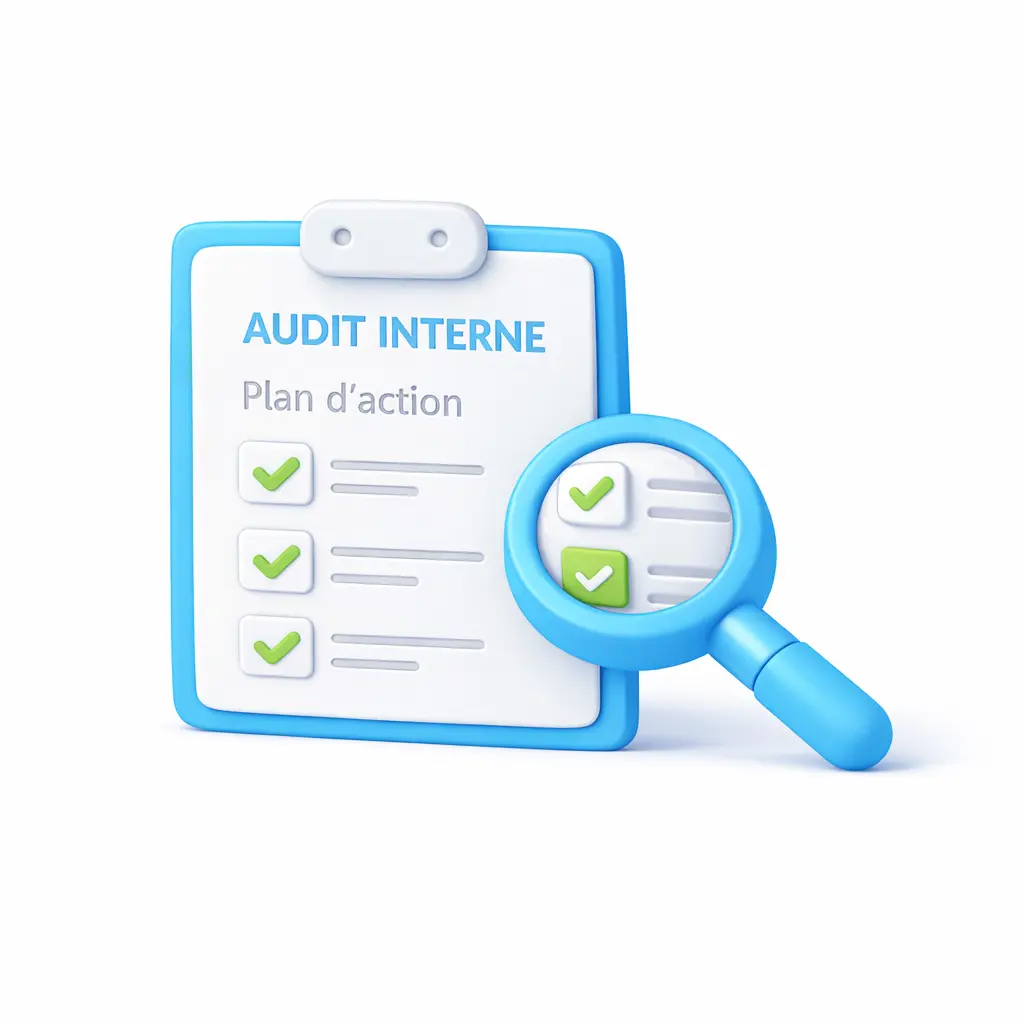
Create, plan and organize your internal audit assignments, documenting all relevant aspects of each audit.
Provide detailed descriptions of the objectives, scope and criteria for each assignment, to facilitate their completion and follow-up.
Make the link with elements of your managed or unmanaged risk mapping via our dedicated module.
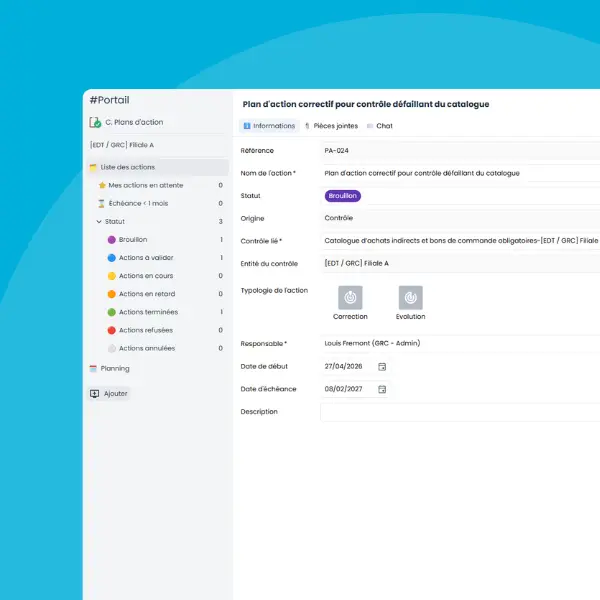
Develop and implement specific recommendations and action plans for your audit findings.
Monitor the progress of corrective actions.
Interact with managers via the application's integrated chat function, and make sure they are effectively implemented.
Conduct your internal audits following clearly defined and documented steps.
Define the list of documents to be collected from auditees, carry out a pre-analysis/risk assessment, then during the testing phase use checklists, questionnaires and templates to guarantee the consistency and quality of your audits.
Document your observations, conclusions and recommendations in a structured way in standardized, customizable reports.
Ensure regular communication with all stakeholders thanks to indicators and reports covering all stages of your audit assignments (and adapted to different types of profile: auditee, COMEX, contributor, audit manager, auditor, etc.).
Anticipate, assess and manage the risks and control points identified during your audits to strengthen your organization's governance.

Grâce aux tableaux de bord disponibles, monitorez vos missions de la préparation à la clôture.

Créez et planifiez vos missions : objectifs, périmètre, calendrier, équipe.
Une fois lancée, tout s’automatise : notifications, rappels, alertes aux jalons clés. Vous n’avez pas à intervenir, vous êtes informés à bon escient.
Sélectionnez les contrôles à tester, documentez vos constats (résultat, preuves, écarts observés) et centralisez les échanges avec les audités, du cadrage jusqu’à la collecte des documents.

Formalisez vos recommandations, priorisez-les selon leur enjeu (P1, P2, P3) et suivez la mise en œuvre des plans d’action jusqu’à leur clôture avec une vue d’ensemble sur l’avancement de chaque mission.
Suivez l’exécution du plan d’audit, l’avancement des missions, les non-conformités, les recommandations et les actions correctives.
Les restitutions s’adaptent aux auditeurs, à la direction de l’audit, aux métiers ou au COMEX.

"Une excellente coordination pour atteindre nos objectifs"
"It's a real pleasure working with you"
"The team stands out for its great responsiveness"
"Responsive and flexible"
"The flexibility of their solution and the quality of their support"
"Values Associates successfully met our needs"
"Extremely satisfied"
By providing an independent assessment of processes and controls, internal auditing plays an essential role, whatever the size, activities or sector in which a company, community or public authority operates. By examining processes and operating procedures, internal auditing fosters a culture of continuous improvement.
By shedding light on the organization’s performance and risks, internal audit activities help to build confidence among the various stakeholders, as well as contributing to the organization’s sustainability, image and reputation.
Choosing collaborative internal auditing software that adapts to your specific context enables you to automate and facilitate the auditing of processes and activities involving numerous contributors. You’ll always have an up-to-date view of all your internal audit activities, and be able to monitor them in real time.
Thanks to reporting and data visualization functions based on datavisualization, both private and public sector players have access to a real-time dashboard enabling them to effectively manage their internal audit activities.
Thanks to reporting and data visualization functions based on datavisualization, both private and public sector players have access to a real-time dashboard enabling them to effectively manage their internal audit activities.
Using our internal audit software, you’ll find an environment that brings together all the fields characterizing your different audit assignments: objectives and scope of the intervention, methodology for conducting the assignment, documents and information to be collected, deliverables, timetable, key milestones, contributors, dates of interviews, tests or controls,….
Depending on the nature of your audit, you can easily update the necessary rules and procedures repositories and associate specific reference documents: assignment order, audit charter, previous audit reports, description of processes to be audited, flow diagrams, risk maps, control activities, organization chart, task description and analysis grid, delegations of authority, repositories, professional standards, contracts, key figures, etc.
You can also insert review, control and validationstages, send out questionnaires, including web questionnaires that will save your contributors logging on to the internal audit software.
Internal auditing is an independent and objective activity that evaluates and improves an organization’s operations.
By providing advice and assurance on risk management, internal control and governance processes, internal audit aims to strengthen the effectiveness of internal processes and add value.
Internal auditing is crucial to managing risk, ensuring regulatory compliance, improving internal controls, preventing fraud and optimizing operations.
By checking that the organization complies with standards, identifying weaknesses and proposing improvements, internal auditing helps to maintain transparency and integrity within the organization.
An effective internal audit program is based on the independence and objectivity of the auditors, their competence and qualifications, a risk assessment to prioritize the areas to be audited, structured planning with clear objectives and defined methods, and the documentation and follow-up of findings and recommendations.
Our internal auditing software is fully configurable and adapts to your organization’s specific needs. It integrates easily with your ERP, CRM and other systems. With customized dashboards and real-time reports, it enables efficient management and transparent communication with all stakeholders. What’s more, our technical support and guidance ensure that you get the most out of your system.
Our internal auditing software is fully configurable and adapts to your organization’s specific needs. It integrates easily with your ERP, CRM and other systems. With customized dashboards and real-time reports, it enables efficient management and transparent communication with all stakeholders. What’s more, our technical support and guidance ensure that you get the most out of your system.
Our software allows for documenting each audit by associating specific risks identified in the corruption risk mapping. It helps demonstrate compliance by providing formal evidence to the French Anti-Corruption Agency (AFA) that risks are effectively managed. Monitoring the implementation of recommendations is simplified, ensuring that corrective actions are executed and their effectiveness evaluated.