
An all-in-one solution that centralizes and simplifies the process for managing sponsorship, sponsoring and philanthropy activities under the Sapin 2 law, while adapting to your organization.
Incorporate any specific features of your organization related to the different categories of philanthropy, sponsorship and third-party requests, ensuring accurate management that complies with the specifics of each situation. A questionnaire sent to the beneficiary third party enables the collection of details and supporting information on its tax, accounting and social situation.
Once the initial declaration information has been completed, an automated check verifies its compliance with your organization’s internal policies, providing a first layer of validation.
If the automated check identifies the need for validation, the declaration is then escalated, adding a level of human review. A reputational due diligence review, carried out by the Compliance team or a specialized lawyer, makes it possible to verify the beneficiary’s credibility and reputation.
A contract detailing the terms and conditions of the philanthropy or sponsorship is diligently prepared based on the information collected and signed by the parties involved (requester, approver, beneficiary third party).
Ensure regular communication with all stakeholders through KPIs and reporting covering the different stages of your framework and enabling you to assess and manage gifts and hospitality declarations within your organization. When a philanthropy or sponsoring operation is approved and payment has been made, the requester must demonstrate the effective implementation of the operation to ensure compliance with the Sapin 2 law.
Evidence such as photos, scans, or other supporting documents must be provided to confirm that the supported project has been carried out.
With centralized documents related to a sponsorship (sponsoring) or philanthropy request: information and documents submitted by the requester, information collected from the third party (K-Bis, tax, accounting and social situation, etc.), analyses and evidence supporting reputational due diligence reviews, etc.
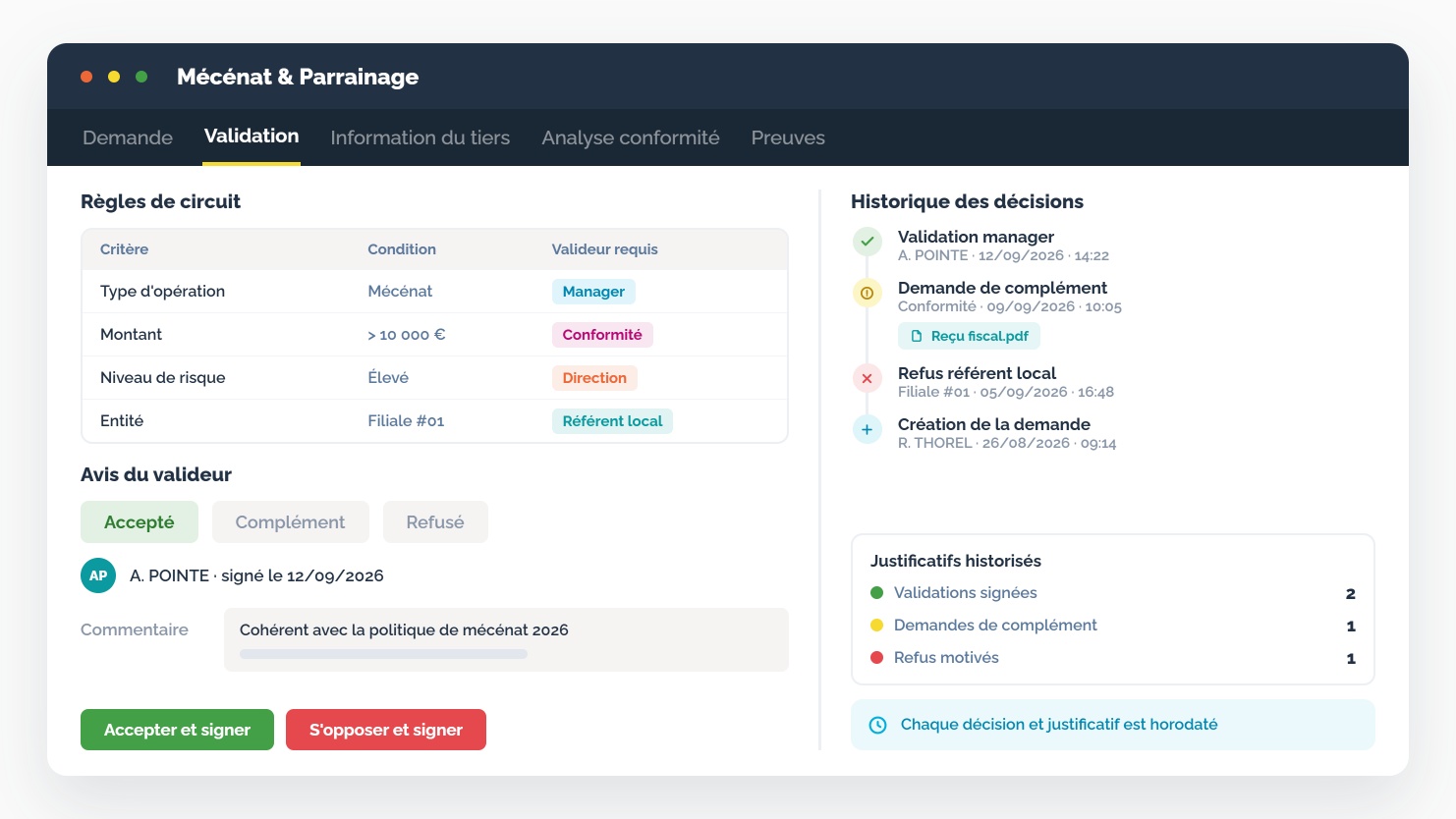
Un contrôle automatisé confronte chaque déclaration aux politiques internes dès sa saisie.
Lorsqu’il signale un point d’attention, la demande est escaladée : la Conformité ou un avocat spécialisé mène l’enquête de réputation sur le bénéficiaire.
Le contrat est ensuite préparé à partir des éléments collectés, puis signé par le demandeur, le validateur et le tiers.

De la demande motivée à la preuve de réalisation, chaque étape est tracée au même endroit : validation par votre entité, justificatifs fiscaux, comptables et sociaux du tiers, enquête de réputation, contrat signé, puis pièces justifiant la mise en application du mécénat.

Des indicateurs couvrant chaque étape du dispositif donnent une vue partagée de l’avancement des déclarations de mécénat et de parrainage.
Une fois l’opération validée et payée, le demandeur dépose les preuves de sa réalisation : photos, scans ou tout autre justificatif, comme l’exige Sapin 2..

Chaque demande réunit au même endroit les documents déposés par le demandeur, les pièces collectées auprès du tiers (K-bis, situation fiscale, comptable et sociale) et les analyses issues de l’enquête de réputation.



"Une excellente coordination pour atteindre nos objectifs"

"It is a real pleasure working with you"
"The team stands out for its responsiveness"
"Responsive and flexible"

"The flexibility of their solution and the quality of their support"

"Values Assocites was able to provide a solution tailored to our needs"

"Extremely satisfied"
Sponsorship and philanthropy are direct material, financial and human support provided by a company or public body to an individual or legal entity. As soon as there is consideration and exchange, the risk of corruption exists.
Support for cultural, sporting and social practices, promotion of the organization’s positive values, advertising and commercial benefits, employee engagement: sponsorship and philanthropy operations appeal to companies, administrations and local authorities. However, although governed by strict legal and tax rules, they create a vulnerability within the organization. As soon as consideration exists, the risk of corruption arises.
➡️ Concealment of undue professional and personal benefits under the guise of sponsorship and philanthropy: payment of a sum of money, free loan of premises, negotiated prices, etc.
➡️ Misuse of consideration to corrupt employees and obtain professional or personal benefits: obtaining a contract or public procurement award, speeding up a procedure
➡️ Misappropriation of funds to finance, with the help of sponsorship and philanthropy donations, a project unrelated to the operation.
➡️ Using sponsorship to circumvent public procurement procedures and favor a supplier.
By customizing each form based on the requester, the type of operation, the request status, the amount of the operation, or the date the funds are paid.
Our solution enables you to thoroughly assess the third parties involved by specifying their identity, tax situation, geographic location, associated risks, and any other relevant information.
You also strengthen your ability to monitor and anticipate potential deviations by verifying the nature of the operations, the types of beneficiaries, the amounts allocated, and the compliance of consideration with your gifts and hospitality policy.
Finally, our module integrated into the Sapin 2 software promotes effective collaboration thanks to advanced features such as chat functionality and an integrated notification system. This ensures smooth communication and optimal management of risks related to sponsorship and philanthropy activities, while meeting your organization’s regulatory and ethical requirements.
Whether symbolic or clearly stated, consideration goes hand in hand with the risk of corruption.
Because of the links created between the public and private sectors, as well as between professional and personal spheres, sponsorship and philanthropy weaken the organization. Corruption risks are numerous. Depending on the case, they may also involve favoritism, influence peddling, or unlawful taking of interest.
The company, administration or local authority can protect itself by deploying strict measures proportionate to the organization’s risk profile and that of its beneficiary entities:
Sponsorship and philanthropy involve providing material, financial or human support to a legal entity or an individual. Philanthropy encourages activities in the public interest. Sponsorship more broadly supports a person, product, event or organization with an educational, sporting, cultural, social, artistic or environmental purpose. This is the description used in the latest AFA guide on sponsorship and philanthropy under the Sapin 2 law.
What is the difference between these two communication operations? Consideration. Philanthropy is a charitable act, with no direct or indirect consideration. Sponsorship is carried out with the aim of obtaining a direct advertising, reputational and/or commercial benefit.
Managing these risks is essential to:
Software for managing the risks of sponsorship and philanthropy activities is a technology solution designed to help companies and organizations manage and mitigate the risks associated with their sponsoring and philanthropy initiatives. While these activities benefit the company’s image and the community, they can involve ethical, legal, financial or reputational risks.
The main risks include: