Our Philanthropy and Sponsorship software enables organisations to centralise, review and track philanthropy, sponsorship and sponsoring requests.
It structures forms, applies approval workflows, logs decisions, and makes it easier to demonstrate your procedure in the event of an inspection.
Requests come in by email, phone or internal referral. They are handled case by case, with no shared form, no consistent workflow, and insufficient traceability of decisions.
Each request is entered into a structured form, tailored to the type of transaction, the amount, the requester’s status and the expected supporting documents. The approval workflow is built in, and each decision is logged.
Each request follows the same protocol. The audit trail is clear, usable and available in the event of an inspection or internal audit.
You manage many requests each year. Decisions are split across multiple stakeholders, committed amounts are difficult to consolidate, and reporting lacks reliability.
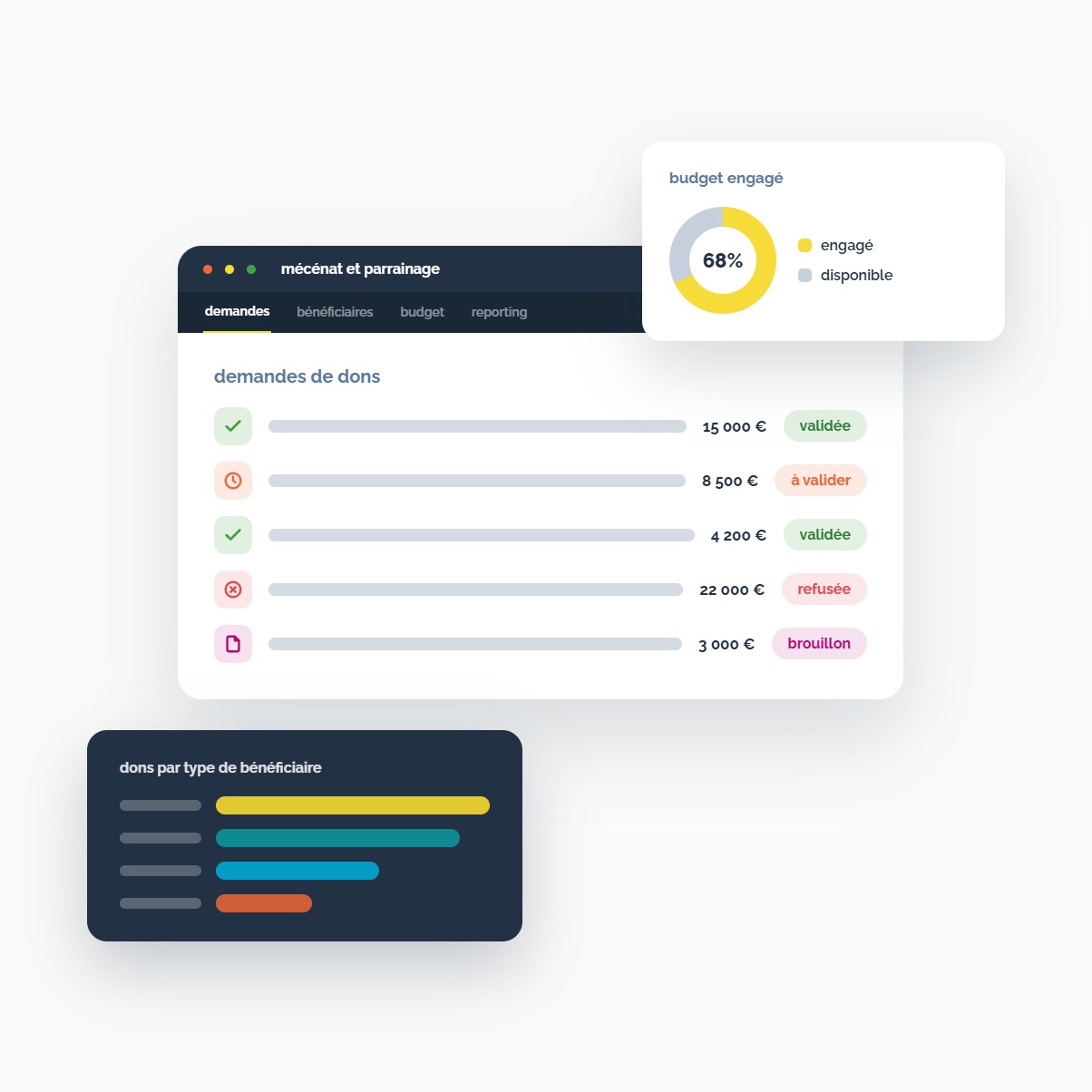
Our software centralises all requests in a single dashboard. Each transaction is assigned, tracked, approved or rejected in line with your internal procedure. Amounts, statuses and decisions are consolidated.
You manage your philanthropy, sponsorship or sponsoring activity from a single tool, with a clear view of amounts, statuses and decisions.
Your procedure exists, but requests, supporting documents and decisions are scattered across several departments. Producing clear evidence that the procedure is applied takes too much time.
Our software centralises the documentation for each transaction: form, supporting documents, approvals, rejections, comments and decision history.
You have a structured, usable file, without last-minute reconstruction ahead of an inspection or an internal review.

From the reasoned request to the proof of completion, every step is tracked in one place: validation by your entity, the third party’s tax, accounting, and social supporting documents, reputation inquiry, signed contract, and then documents justifying the implementation of the sponsorship.
An automated control checks every declaration against internal policies as soon as it is entered.
When it flags a point of concern, the request is escalated: Compliance or a specialized attorney conducts the reputational investigation on the beneficiary.
The contract is then prepared from the information collected, and signed by the requester, the validator, and the third party.

Indicators covering each stage of the framework provide a shared view of the progress of patronage and sponsorship declarations.
Once the transaction has been approved and paid, the requester submits proof of completion: photos, scans, or any other supporting document, as required by Sapin 2.

Each request brings together the documents submitted by the applicant, the records collected from the third party (K-bis, tax, accounting, and social status), and the analyses from the reputation investigation.
Intuitive and fully customisable, it becomes a true management tool for this activity and helps you identify and analyse efficiently the risks your organisation is exposed to.
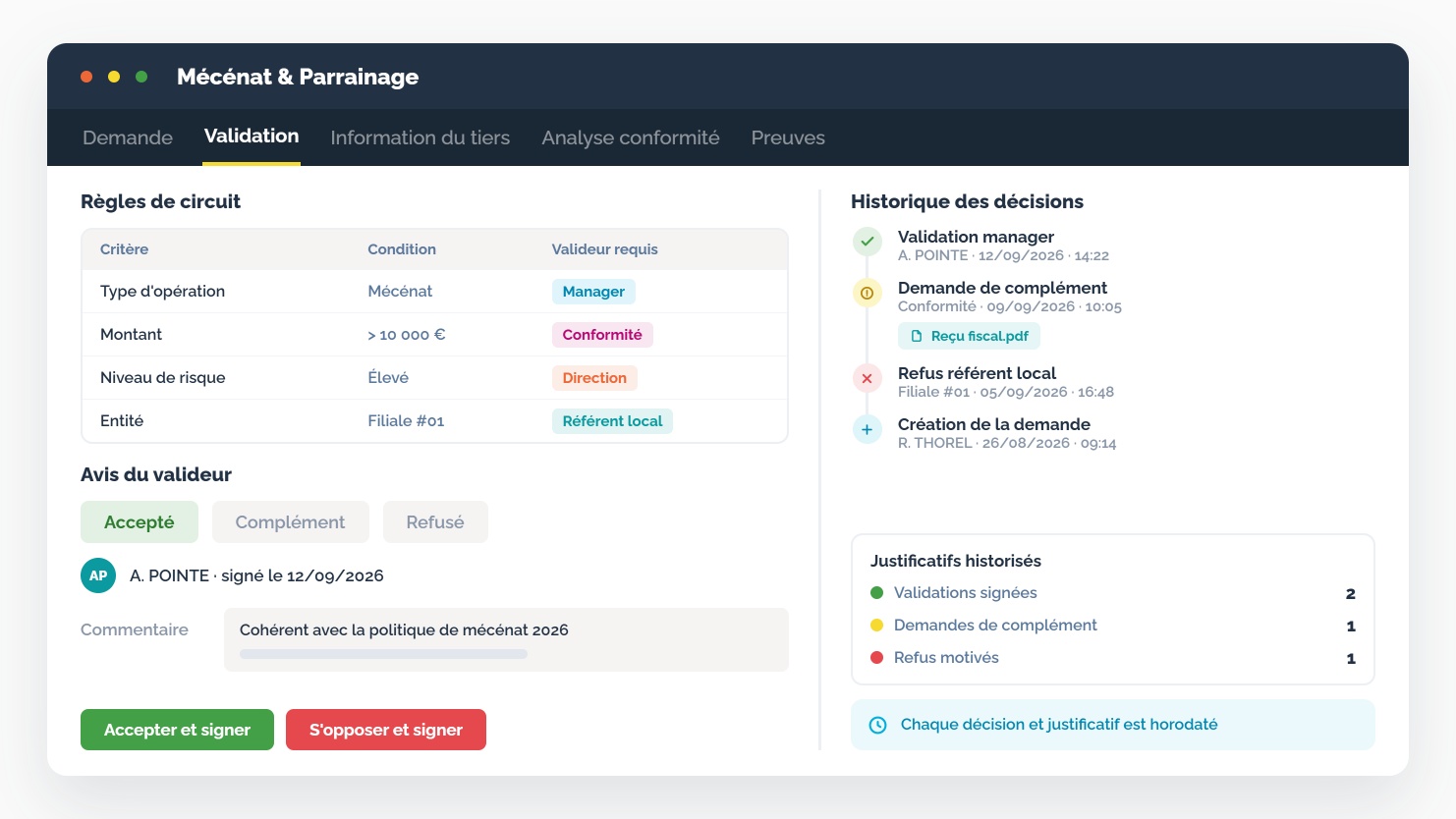
Your internal rules quickly become operational: transaction types, thresholds, approval workflows, supporting documents and escalations are applied consistently.
Each request, decision, comment and supporting document is centralised and logged. The audit trail is usable without manual reconstruction.
Philanthropy, sponsorship, sponsoring: tailor forms, fields, thresholds, supporting documents and approvals to your internal policy and the type of transaction.
Our Philanthropy and Sponsorship software works on its own. It can also be connected to the other Sapin 2 components to progressively build a more comprehensive anti-corruption programme.
Show us your process. We will present the tool best suited to your context, then discuss your project to define the most appropriate support.

Our Philanthropy and Sponsorship software can be used on its own or integrated into our Sapin 2 solution to link your actions to the other components of your anti-corruption programme.
Declare your philanthropy and sponsorship transactions in a single software tool, with its anti-corruption business content. You address a specific need without taking on an entire programme.
Integrate the tracking of your philanthropy and sponsorship transactions into the programme’s 8 components for a consolidated view, shared data and a single file ready for any inspection.
Three engagement levels depending on your maturity regarding anti-corruption accounting controls procedures and the complexity of your organisation.
As part of a Sapin 2 programme, philanthropy, sponsorship or sponsoring transactions must be governed by a clear procedure to limit corruption risks or influence peddling.
Our software helps apply this procedure and track the decisions made.
Sponsorship and sponsoring generally involve a consideration, such as visibility or association with an event. Philanthropy is support without direct consideration, often for the public interest.
Our software allows you to tailor forms and approvals to each type of transaction.
Yes. You can define approval levels based on the amount, the type of transaction, the entity or the risk level: direct approval, manager review, compliance approval or escalation to management.
With the Essential offer, deployment can take less than a week using preconfigured content.
With the Configurable offer, allow around 3 weeks to tailor forms, transaction types, thresholds and approval workflows.
With the Made-to-measure offer, typically between 2 and 4 months depending on the complexity of your organisation.
Yes. Our Philanthropy and Sponsorship software can be deployed on its own.
It can also be progressively integrated into our Sapin 2 solution if your organisation wants to cover other components of its anti-corruption programme.
No. Our software helps structure requests, apply approval workflows, centralise supporting documents and track decisions.
The quality of the programme also depends on the internal rules defined, the checks performed and the decisions made by the organisation.