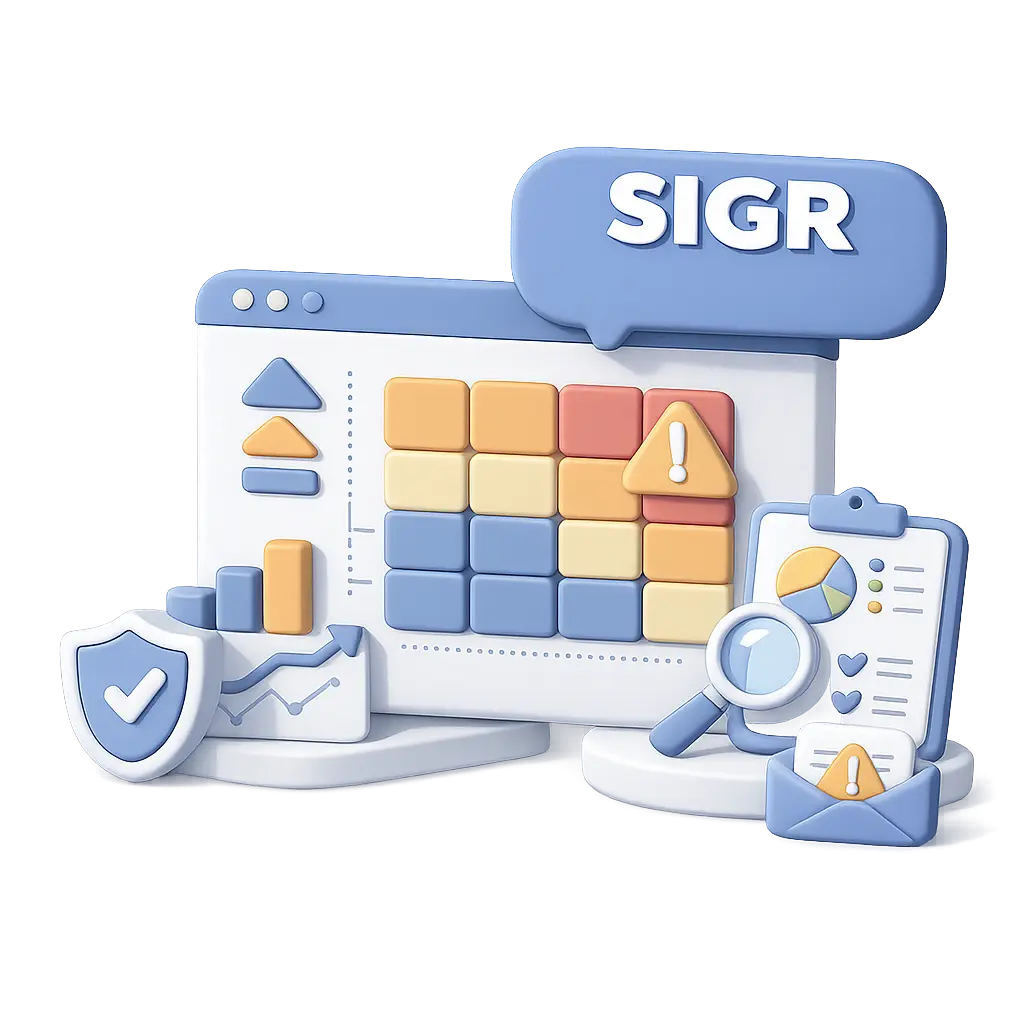
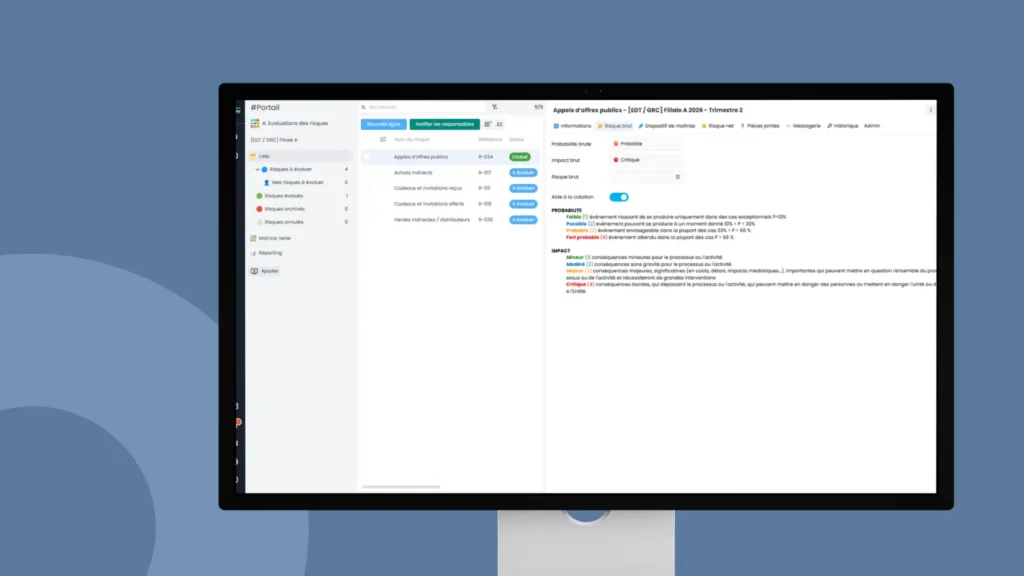
Our SIGR Core Platform offers a wide range of features.
They can be easily and quickly adapted and customized to the specificities of your approach and organization. The risk mapping module can be interfaced with the internal audit, internal control, or compliance modules.
All these modules include features for defining and monitoring action plans. Reporting options, particularly in the form of data visualizations, facilitate the management of the work carried out. This set constitutes a strong internal communication lever regarding your activity and the actions taken to secure your organization’s risk management.
The principle of the proprietary, 100% made in France no-code core that we developed for risk management activities is to allow the implementation of digital tools quickly and securely for your data. Via simple and intuitive visual interfaces, the configuration of your software is facilitated and accelerated.
It is thus possible to transpose your various management rules. For example, you can integrate different risk mappings, each with its own specificities and processes. You can independently configure the fields: creation, adjustment, deletion. These fields can be of any type:
checklist, text, numeric, attachment, etc. They can be optional, mandatory, or conditional. Everything is possible… or almost, in the digitalization of your risk management.
Create as many rules, processes, and features as you wish in your RMIS platform.
For example, integrate as many risk mappings as necessary, each with its own specificities. You are autonomous within the solution to easily configure risk documentation fields. These can be created, adjusted, or deleted intuitively in no time. Fields to be documented can be provided in text, numeric, or checklist formats, or as attachments, and can be optional or mandatory. They can be conditional to adapt to your organization's needs.
Our RMIS (Risk Management Information System) core is simple, intuitive, and practical to use. No more heavy training required to involve the various stakeholders in your risk management activity. You can engage different contributors by relying on features and processes that can be taken over by uninitiated employees in your organization: contextualization of actions to be performed, notifications, alerts, reports, etc.
The GRC Software (Governance, Risk & Compliance) is configurable to facilitate the transposition of your processes, even the most complex ones. It facilitates the collection, exploitation, centralization, and reporting of useful information. You limit time-consuming tasks while securing your activity.
Our SIGR Core Platform supports you whatever your need, profession, or function: risk manager, internal auditor, internal controller, or compliance officer. Your missions are transversal by nature. They rely on strong prerequisites: involving a large number of employees in your organization, and collecting, sharing, analyzing, and consolidating data flows.
Evolve your RMIS platform independently: configure the necessary adjustments to adapt to changes in your organization or your regulatory environment.
"Une excellente coordination pour atteindre nos objectifs"
"It is a real pleasure to work with you"
"The team stands out for its great responsiveness"
"Responsive and flexible"
"The flexibility of their solution and the quality of their support"
"Values Associates was able to provide a response tailored to our needs"
"Extremely satisfied"
RMIS stands for Risk Management Information System.
These are software solutions that collect, store, analyze, and manage data and activities related to an organization’s risk management. Defining it more precisely is a complex exercise. A variety of professions revolve around risk management challenges. Each function may handle a specific aspect. This diversity is reflected in the main users of the tools available on the market.
RMIS (Risk Management Information Systems) and GRC (Governance, Risk, and Compliance) both represent systems for the control and management of risks.
As the acronym GRC also refers to another type of software, the acronym RMIS is preferred today.
An RMIS platform uses data from multiple sources which can come from various origins: external sources, data from the organization’s information system, or data entered directly into the tool via specific workflows and management rules.
A Risk Management Information System (RMIS) covers a wide range of activities, providing companies with an overview of their risk profile and strategies to manage these risks effectively.
Relying on an RMIS information system means:
An RMIS platform offers real gains in time and performance. It frees risk management stakeholders from time-consuming administrative and data consolidation tasks so they can focus on analysis. It facilitates delegation. It helps in making fast and effective strategic decisions and in the concrete deployment of prevention and/or optimization measures.