Our module dedicated to accounting control procedures and the internal control and audit system allows us to meet the requirements of Article 17 of the Sapin 2 law, and more importantly, its interpretation by the French Anti-Corruption Agency.
Controls are associated with each of the risks in your corruption risk mapping and qualified, taking into account their specific needs (existing control, to be implemented or not applicable, frequency, etc.).
All controls identified at the central level will be distributed across all entities (BUs, subsidiaries, etc.) based on the actions and third parties concerned, so that they can adjust the qualification of these controls and define any associated actions.
Each iteration of a control is subject to rigorous monitoring (status, control author (or automatic), due date, completion date, and submission of control evidence, etc.), a key point to ensure your organization's compliance with the Sapin 2 anti-corruption law.
Ensure regular communication with all stakeholders through indicators and reporting covering the different stages of your system, allowing you to evaluate and manage the various documentation activities for Level 1 and 2 controls associated with your organization's corruption risk mapping.
Actions are created from a control or directly from the action plan module.
A planning view and dynamic dashboards optimize the monitoring of action progress and their impact.
Ensure the centralization of control evidence or documents related to action plans.

Procédez à la réalisation de vos contrôles comptables de manière automatisée en connectant directement votre ERP à notre logiciel grâce à l’un de nos connecteurs.
Notre logiciel vous indique automatiquement le résultat du contrôle.

Centralisez et qualifiez vos bibliothèques de processus, risques et contrôles dans un référentiel unique et structuré en cohérence avec votre organisation.
Liez les éléments entre eux pour profiter d’une vision 360° de votre dispositive.
Vous ne savez pas par où commencer, utilisez nos bibliothèques pré-configurés pour démarrer rapidement.

Suivez l’avancement des campagnes, les contrôles en retard, les résultats, les zones de fragilité et les plans d’action associés.
Exportez des rapports prêts pour la direction, les auditeurs ou les autorités de contrôle.
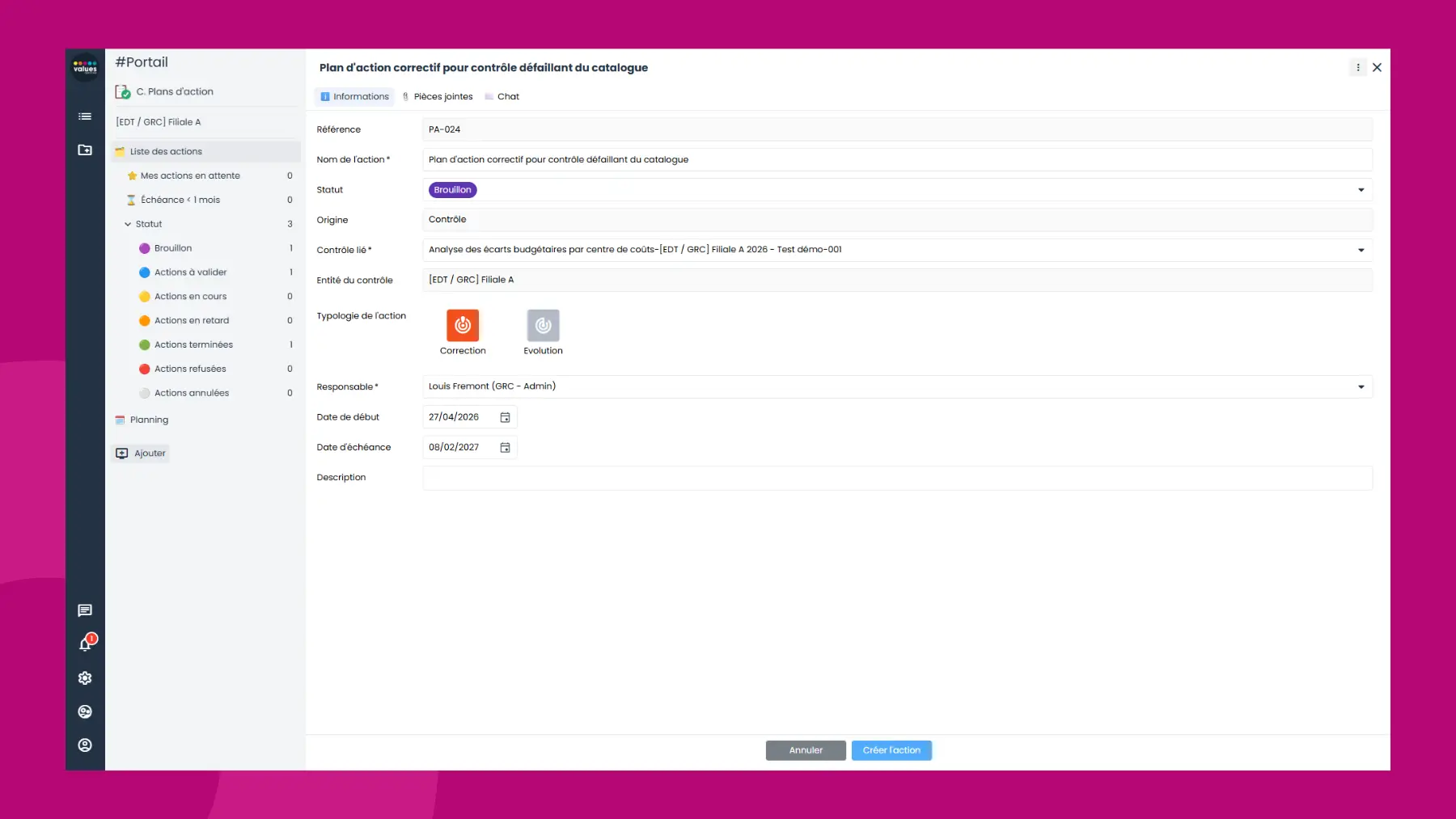
Suivez l’avancement des contrôles de niveau 1 et 2 ainsi que des plans d’actions grâce à une vue planification dédiée.

"Une excellente coordination pour atteindre nos objectifs"

"It's a real pleasure to work with you"
"The team stands out for its great responsiveness"
"Responsive and flexible"
"The flexibility of their solution and the quality of their support"
"Values Associates was able to provide a suitable response to our needs"
"Extremely satisfied"
According to Law No. 2016-1691 of December 9, 2016, known as Sapin 2, companies must implement “accounting control procedures and an internal control and evaluation system for the measures and procedures comprising the anti-corruption system” and ensure that it “covers the risk situations identified in the corruption risk mapping,” that it “is adapted to these risks and capable of controlling them,” and that it “is regularly updated with encountered risk situations and the results of controls performed.”
The module allows you to document, for each of the risks in your corruption risk mapping, all accounting control procedures in place (or to be implemented), at group and subsidiary level, thanks to a powerful and intuitive tool based on no-code.
100% secure, it offers a powerful solution for rigorous and effective control of your financial operations, while respecting the confidentiality of your employees’ data. Deployed alone or in addition to other modules offered by our software suite, the accounting control software helps improve the transparency and accuracy of your financial management.
Manage your accounting processes with increased precision thanks to our dedicated module.
Centralize, automate, and analyze your financial data for better visibility and enhanced control, while facilitating compliance and transparency within your organization.
The accounting control procedures module can be coupled with other modules of the Sapin 2 software solution developed by Values Associates, covering all risk management activities.
Accounting control procedures are systematic processes established to monitor, verify, and validate an organization’s financial transactions. They aim to ensure the accuracy, integrity, and compliance of accounting records with current standards and regulations.
To implement effective procedures:
The main types of accounting controls include:
By automating controls, ensuring constant monitoring, and providing real-time reports, a good accounting control system quickly detects anomalies and suspicious behavior, thereby reducing the risk of fraud. The traceability of actions and data history also strengthen the security of financial processes.
Accounting control software is a computer application designed to help organizations manage, monitor, and improve their accounting and financial control processes. This software is essential for ensuring compliance with accounting standards and regulations, as well as for minimizing the risks of financial errors and fraud.
These procedures are essential for preventing errors, fraud, and financial irregularities. They also ensure compliance with legal and regulatory requirements, strengthen financial transparency, and support informed decision-making within the company.
Accounting controls must comply with national and international standards such as IFRS (International Financial Reporting Standards), GAAP (Generally Accepted Accounting Principles), and regulations specific to your industry or country, such as the Sapin 2 Law in France.
Accounting control software facilitates the automation of verification processes, centralizes data, ensures the traceability of transactions, and improves the speed and accuracy of controls. It also allows for meeting compliance requirements while optimizing the company’s financial performance.
Robust procedures not only minimize financial risks but also strengthen the company’s credibility with investors, regulators, and business partners. They contribute to the organization’s sustainability by ensuring transparent and reliable financial management.