
Third-party due diligence:
a pillar of risk management

In an increasingly interconnected world, companies, local authorities, and administrations operate at the center of a vast relational spider web. At each node of this network lies a partner that exposes the organization to risks, sometimes invisible, often underestimated.

In this context, third-party due diligence is not a simple compliance exercise imposed by law. It is a strategic opportunity to be seized to master the complete risk chain. As a lever for performance and resilience, this proactive approach is a guarantee of sustainability, ethics, and trust for all organizations.

Dive into this key process to strengthen the solidity and security of your third-party network and avoid getting trapped in the web.

What is third-party due diligence?

Third-party integrity assessment consists of analyzing all risks related to the partners with whom the company, administration, or local authority maintains relationships.

The objective? To anticipate and prevent potential threats that could compromise financial stability, regulatory compliance, operational continuity, or reputation.

This proactive vigilance provides the organization with a detailed understanding of its external ecosystem. The identification of weak signals emanating from third parties and the implementation of mitigation and remediation measures for risks strengthen the resilience of the company, local authority, or administration in the face of uncertainties.

Who are the third parties to be evaluated?

Third parties refer to all external actors with whom a company, local authority, or administration maintains relationships.

Numerous and heterogeneous, third parties include strategic partners, suppliers, sensitive clients, and all other intermediaries: buyers, subcontractors, contracting authorities, public contract holders, delegates, grant beneficiaries, service providers, consultants, etc.

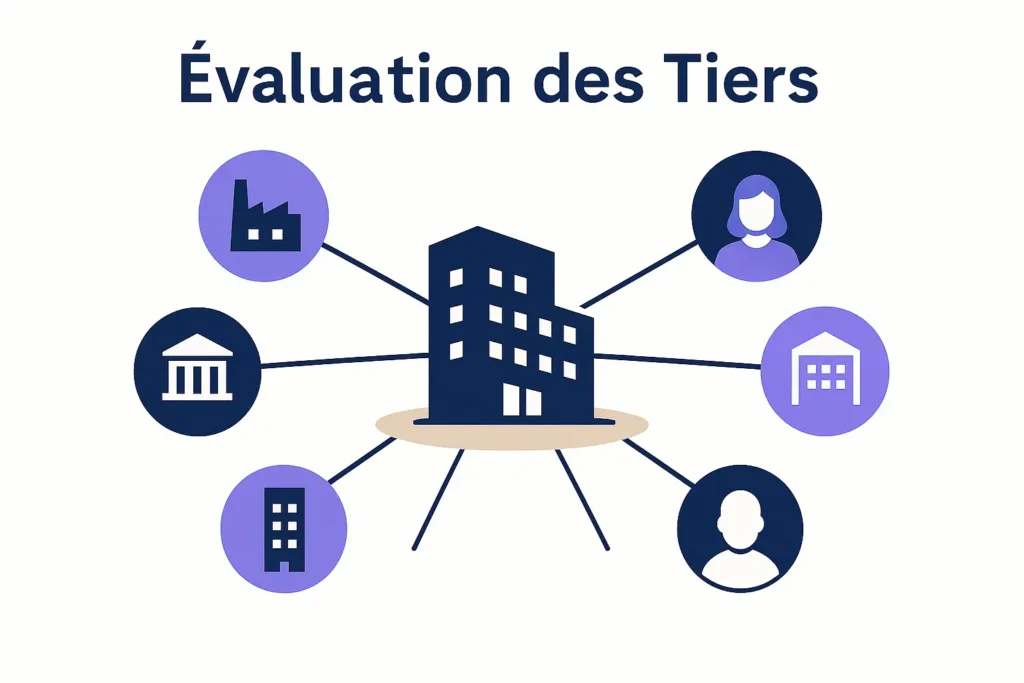
👉 Tier 1 third parties are in a direct relationship with the organization.

👉 Tier 2, 3, or 4 third parties interact via other partners (third parties of third parties).

Partner network within the framework of third-party due diligence.

Third-party due diligence, between regulatory obligation and strategic lever

All companies, local authorities, and administrations are concerned by third-party due diligence, regardless of their size or activities. Evaluating the integrity of third parties is indeed much more than a simple matter of regulatory compliance. It addresses a triple strategic challenge.

Third-party due diligence, a regulatory compliance imperative

Third-party due diligence is first and foremost a regulatory obligation: this system is one of the eight pillars of the Sapin 2 anti-corruption law. Under penalty of sanctions, Article 17 requires large companies, local authorities, and administrations to implement an internal compliance program to fight corruption.

Third-party integrity assessment relies notably on risk mapping. This document lists third parties and evaluates their risk level regarding corruption, money laundering, and influence peddling.

Complementary to the Sapin 2 law, other regulatory texts reinforce the requirement for control and transparency of third parties:

  • The Duty of Vigilance law requires parent companies and contracting authorities to evaluate and prevent environmental, social, and corruption risks across their entire value chain, including their third parties.

  • The GDPR (General Data Protection Regulation) obliges all companies, local authorities, and administrations to verify the personal data processing procedures implemented by their third parties, in order to prevent any risk of violation or leak.

Third-party due diligence, a triple strategic challenge for organizations

Beyond the regulatory obligation, every company, local authority, and administration has a genuine strategic interest in deploying a rigorous third-party due diligence policy.
Indeed, in the event of an incident involving a poorly evaluated or non-evaluated third party, the repercussions can be major. The challenge is threefold:

  • A financial challenge: the failure of a supplier, a supply chain disruption, or an environmental disaster caused by a third party generates heavy financial losses (fines, drop in turnover, loss of customers and capital, budgetary imbalance, etc.).

  • A legal and social challenge: the regulatory non-compliance of a supplier, the corruption of a third party, or a case of human rights violation leads to legal proceedings and erodes the trust of investors, who are sensitive to ESG (environmental, social, and governance) criteria.

  • A reputational challenge: maintaining relationships with a supplier involved in illegal corruption practices or social or environmental violations durably tarnishes the image of the company, local authority, or administration.

Third-party due diligence, a value-creating approach

An effective third-party due diligence system supports attractiveness, sustainability, competitiveness, and trust.

Its benefits are numerous:

Reliability

and securing of operations and business processes

Anticipation

and control of incidents and risks

Optimization

of overall performance

Improvement

of partner and customer trust

Third-party due diligence: how to put it into practice?

Illustration vectorielle d’une checklist et d’une loupe représentant la définition des objectifs et des risques dans l’évaluation des tiers.
#1 Framing the approach

How to frame the third-party due diligence process

Every context is specific. Every organization is unique. Before engaging in a third-party due diligence process, the company, local authority, or administration must precisely define its scope, objectives, and challenges:
  • Which third parties are concerned?
  • What are the risks to be evaluated? Corruption, financial, social, environmental, technical, organizational, IT, compliance, or cybersecurity risks?
  • Do all third parties represent the same level of risk? Which third parties should be evaluated as a priority, whose failure, corruption, lack of integrity, or non-compliance would have a major impact on the organization?
  • What criteria should be taken into account for the risk level assessment?
  • What are the regulatory requirements applicable to the third party, as well as to the company, local authority, or administration? Are they subject to the Sapin 2 law, the duty of vigilance, GDPR regulations, or extraterritorial anti-corruption regulations (FCPA – Foreign Corrupt Practices Act, UK Bribery Act)?
  • What is the acceptable risk level for the organization and its resilience capacity?
#1 Framing the approach
Illustration vectorielle d’une checklist et d’une loupe représentant la définition des objectifs et des risques dans l’évaluation des tiers.
Illustration vectorielle de silhouettes et d’icônes symbolisant une gouvernance dédiée au pilotage de l’évaluation des tiers.
#2 Setting up a dedicated governance

Setting up a dedicated governance for third-party due diligence

The governance of third-party due diligence must also be defined upstream to guarantee the effectiveness of the system.
It is based on:

  • The appointment of a manager to lead third-party due diligence and guarantee process compliance (compliance officer, risk manager, etc.).
  • The definition of clear procedures to ensure the consistency and rigor of practices.
  • The involvement of all internal and external stakeholders to cover all issues (executives, elected officials, business teams, purchasing – legal – IT – accounting – finance functions, suppliers, service providers, subcontractors, international entities, etc.).
#2 Setting up a dedicated governance
Illustration vectorielle de silhouettes et d’icônes symbolisant une gouvernance dédiée au pilotage de l’évaluation des tiers.
#3 A rigorous evaluation process

Carry out and document your audit assignments

Conduct your internal audits following clearly defined and documented steps.

Define the list of documents to be collected from auditees, carry out a pre-analysis/risk assessment, then during the testing phase use checklists, questionnaires and templates to guarantee the consistency and quality of your audits.

Document your observations, conclusions and recommendations in a structured way in standardized, customizable reports.
#3 A rigorous evaluation process
Illustration vectorielle d’un écran et d’icônes numériques représentant l’usage d’outils performants pour l’évaluation des tiers.
#4 Relying on high-performance tools

The need to rely on high-performance third-party due diligence tools

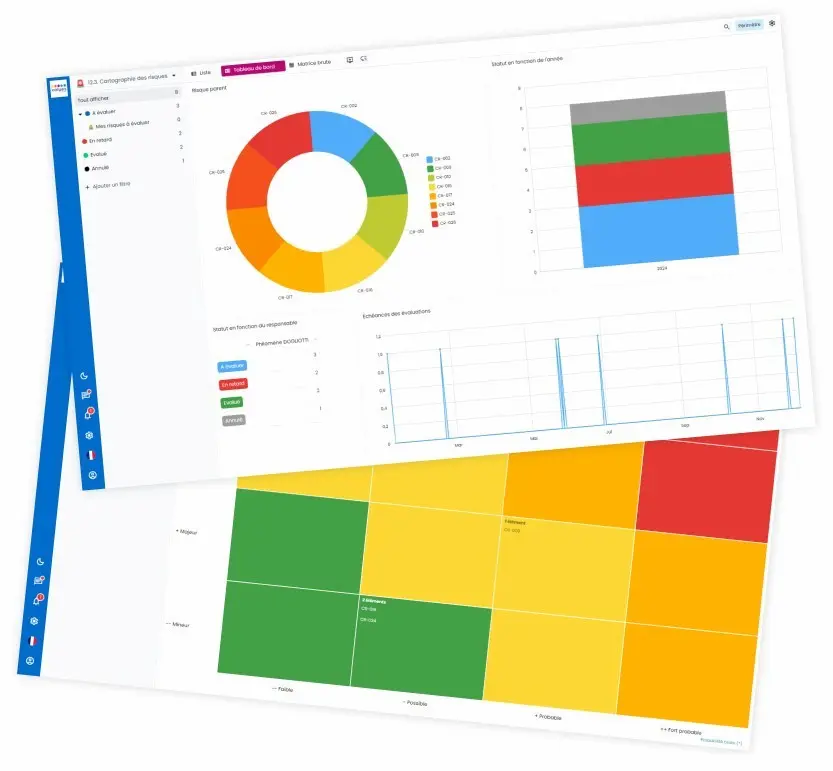
The implementation of third-party due diligence faces many challenges: the volume of information, the diversity of risks, the number of third parties, the requirement for exhaustiveness and customization of procedures, the integration of databases, etc.

These factors make the evaluation process long, complex, and prone to errors, particularly during the creation of third-party profiles, duplicate management, or risk scoring.

Digitalization helps overcome these obstacles. Digital tools simplify, automate, and secure the risk management process, resulting in time savings for teams and productivity gains for companies, local authorities, and administrations.
#4 Relying on high-performance tools
Illustration vectorielle d’un écran et d’icônes numériques représentant l’usage d’outils performants pour l’évaluation des tiers.

Third-party due diligence is not just a legal obligation: it is a genuine strategic choice. As a bulwark against external risks, it is a powerful lever for trust and performance for all companies, local authorities, and administrations. Adopting a proactive, structured third-party due diligence approach supported by high-performance digital tools transforms a constraint into a competitive advantage. The result? A secure, agile, and sustainable company, local authority, or administration.

Discover our solution for third-party due diligence

Intuitive, innovative, and high-performing, Values Associates’ third-party due diligence software simplifies, streamlines, and secures your third-party assessments for efficient and flexible risk management. Thanks to “no-code” technology, our experts configure your personalized platform adapted to your public or private challenges in record time, without any compromise on your requirements.

Are you hesitating to invest in a screening tool?

Our solution harnesses the power of AI to automate and accelerate the information collection phase and evaluate the need to deepen your third-party due diligence.