
This module centralizes and simplifies the process of preventing conflicts of interest, while adapting to the specificities of your organization.
Incorporate any particularities of your organization's conflict of interest prevention and management policy and allow any employee to enter a new disclosure, whether to report a conflict of interest or an absence of conflict of interest.
Ensure regular communication with all stakeholders through indicators and reporting covering the different stages of your system, allowing you to evaluate and manage conflict of interest disclosures within your organization.
Ensure the centralization of documents relating to a conflict of interest request, from information and documents submitted by the applicant, to analyses and reviews, through to any potential action plans.
Once the initial disclosure information is completed, an automated control verifies its compliance with your organization's internal policies, thus guaranteeing a first layer of validation.
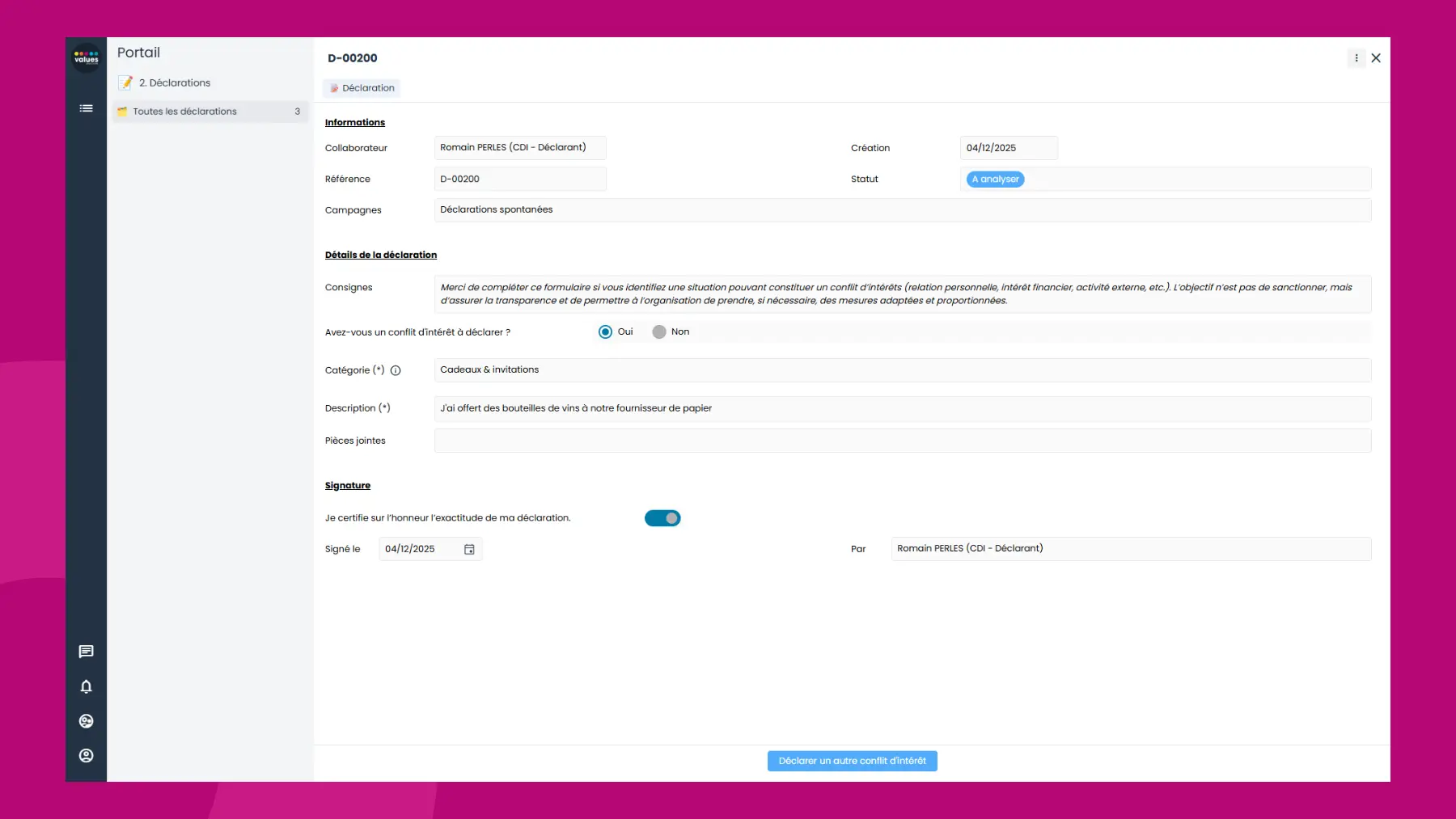
L’ajout, la suppression ou le renommage des champs décrivant une déclaration de conflit d’intérêts ou une actions avec la possibilité de définir les champs obligatoires.
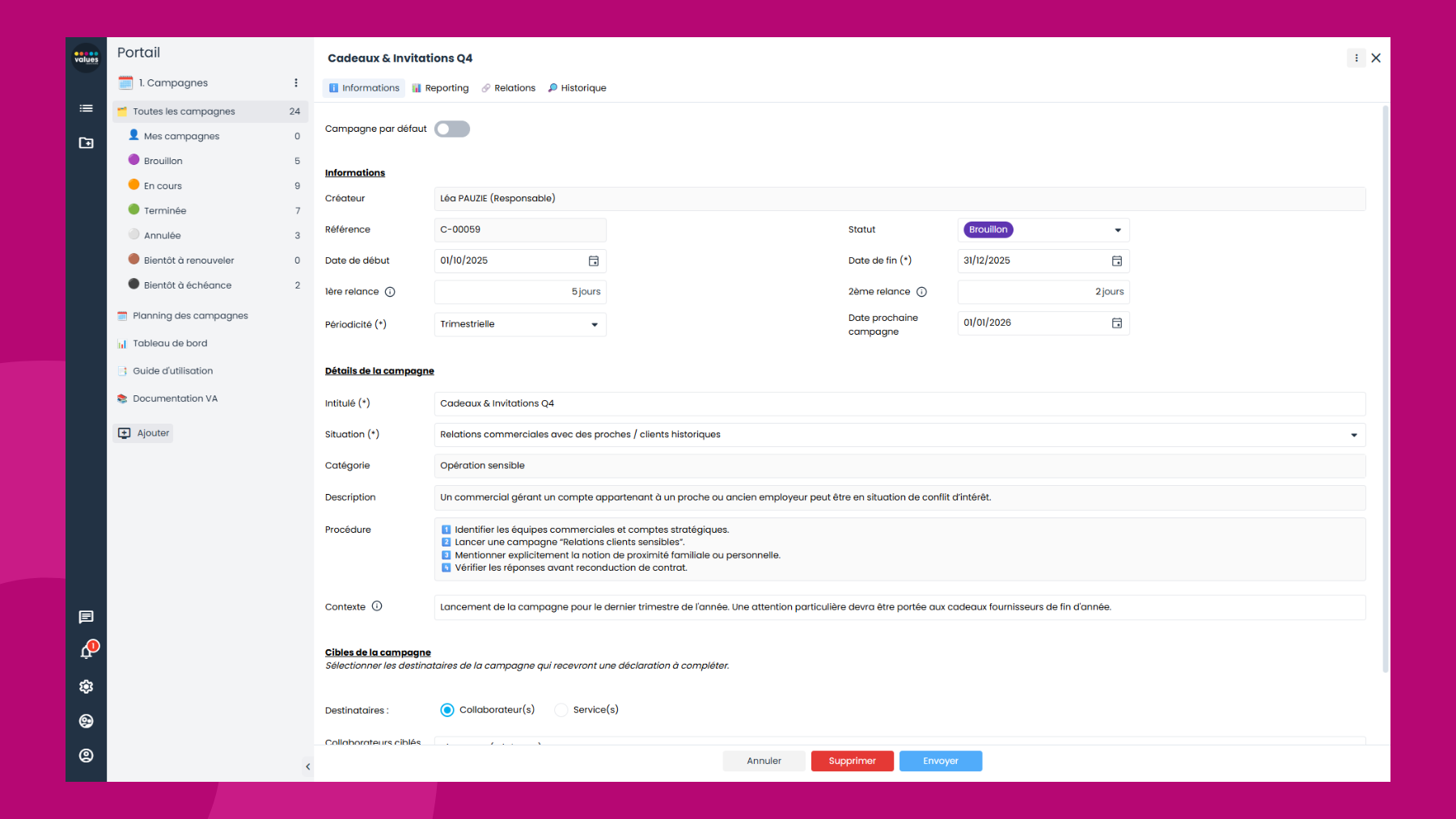
Le paramètrage de l’application permet l’activation de notifications spécifiques pour chaque utilisateur en cas de changement de statut d’un élément, comme lorsqu’une déclaration doit être remplie ou a été terminée, tout en offrant la possibilité de configurer autant de niveaux que nécessaire pour la validation de l’évaluation d’une déclaration de conflit.
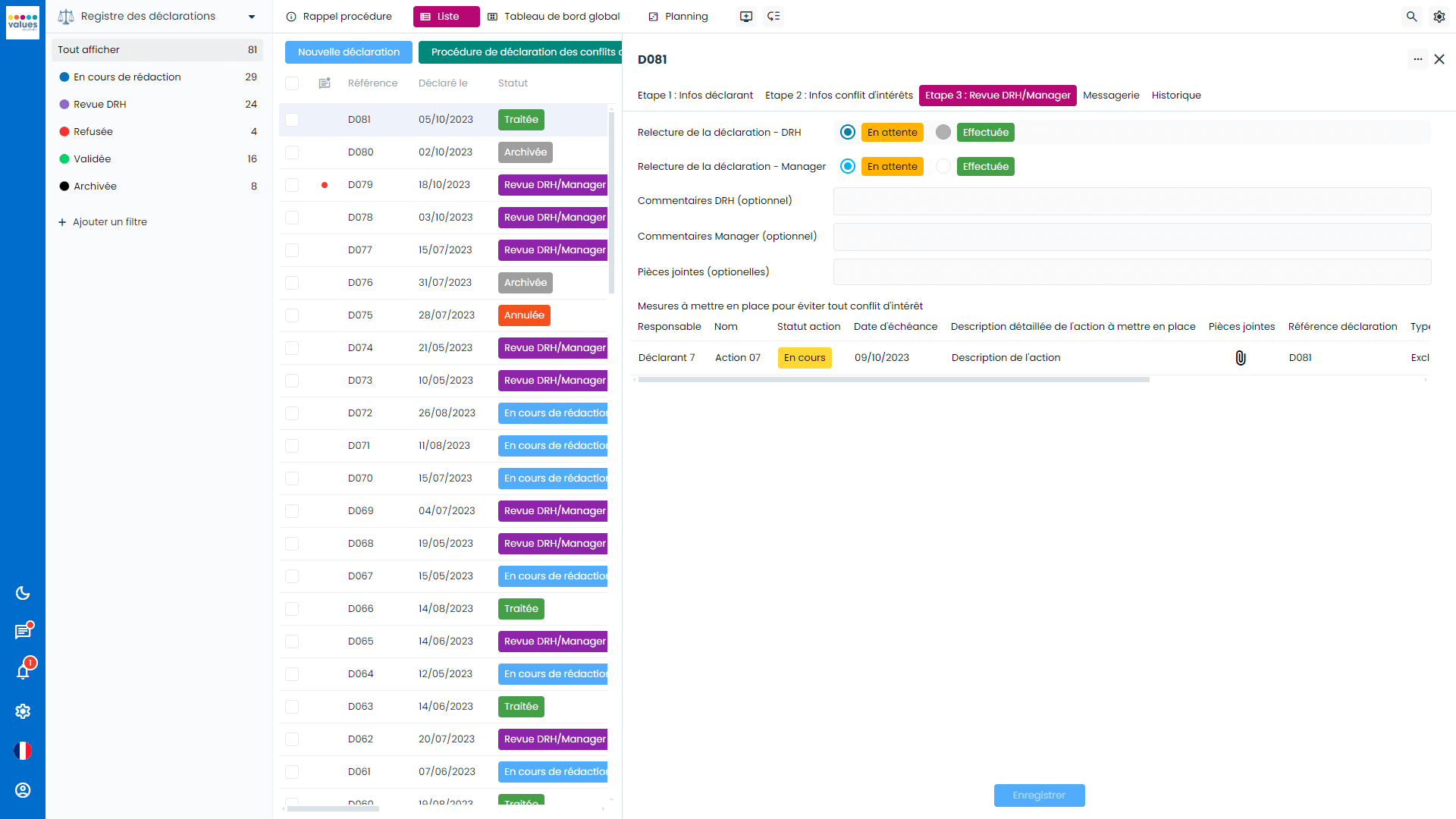
Bénéficiez d’une configuration des critères de scoring pour la nature de conflits, allant des options les plus simples aux plus avancées.
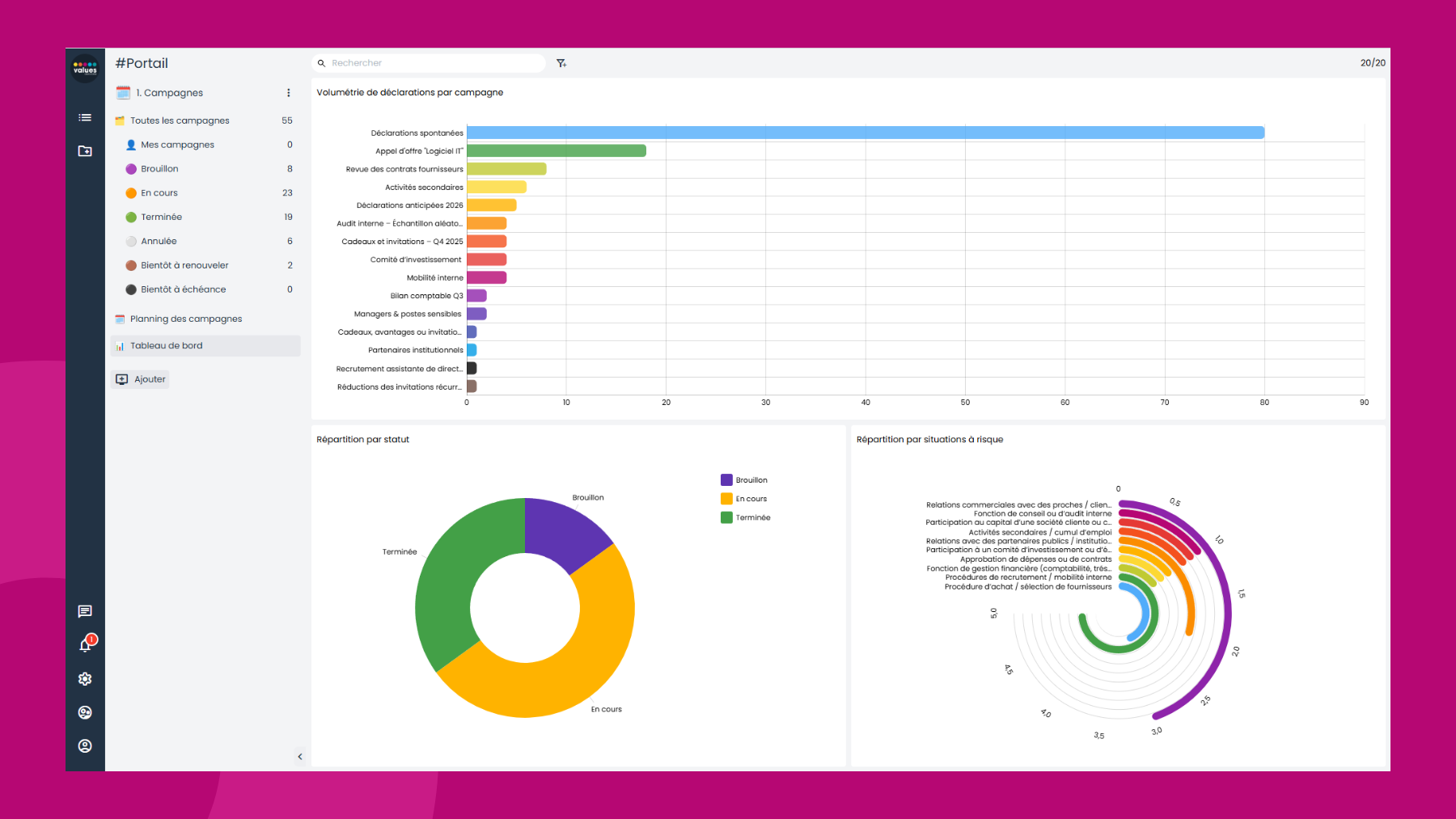
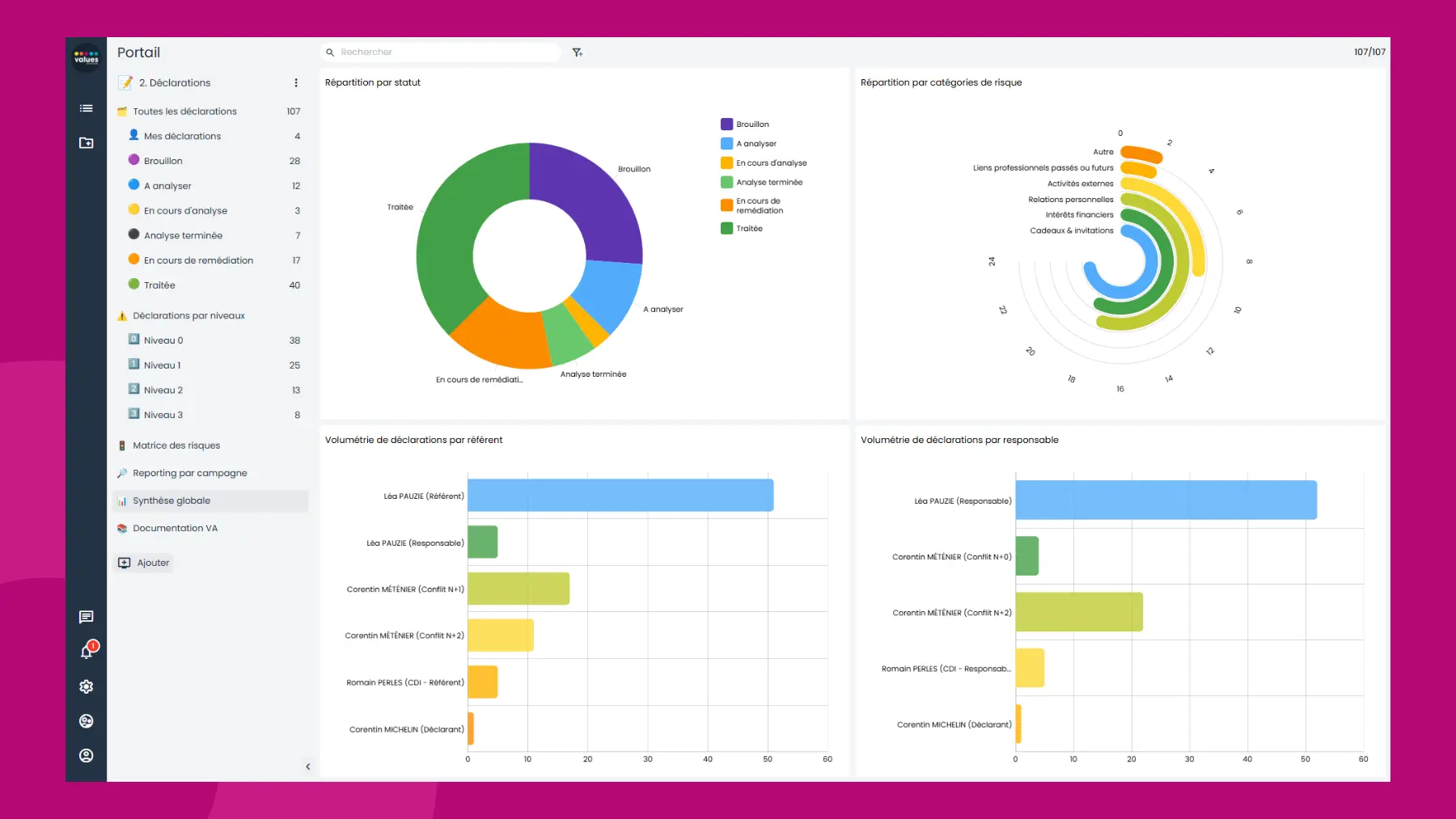
Optez pour des tableaux de bord dynamique et intuitifs vous permettant de consulter votre activité en vue 360° avec des repartitions de données permettant de visualiser l’activité (statut de la déclaration/demande ; répartition par nature de déclaration de conflits d’intérêt ou d’absence de conflits d’intérêts).









"Une excellente coordination pour atteindre nos objectifs"

"It is a real pleasure to work with you"

"The team stands out for its great responsiveness"

"Responsive and flexible"

"The flexibility of their solution and the quality of their support"
"Values Associates was able to provide a response tailored to our needs"
"Extremely satisfied"
In the public sector, conflict of interest is defined by the law of October 11, 2013, relating to transparency in public life. This term describes “any situation of interference between a public interest and public or private interests likely to influence or appear to influence the independent, impartial, and objective exercise of a function.”
In the private sector, no specific text regulates conflict of interest. However, the company is nonetheless concerned by the risk of corruption. By extension, conflict of interest is considered to be any situation where a function performed in an organization, public or private, and a personal interest interfere. Personal interest can be economic, financial, political, union-related, family-related, friendship-based, associative, etc. It can directly concern the person or one of their relatives.
A conflict of interest is, for example, a supplier responding to a call for tenders managed by someone from their family circle. It is also the director of a real estate company wishing to buy communal land in a town administered by a long-time friend. It is also a child applying to the company where one of their parents works.
Conflicts of interest pose a high risk of corruption to the organization due to the ties that unite two people. This is why they are at the heart of the Sapin 2 law, which requires large companies and certain public establishments to identify them in the corruption risk mapping.
A conflict of interest does not in itself constitute a criminal offense. The law punishes its exploitation for personal gain.
The offense of private corruption, the offense of public corruption and influence peddling, or even the illegal taking of interests are severely punished by law. Their common point? All have as a starting point a situation where a personal interest prevails over the interest of the organization and influences action, or non-action.

100% secure, it offers a high-performance solution for a rigorous, effective policy compliant with the Sapin 2 law, while respecting the privacy of your employees.
Manage conflict of interest situations thanks to our module developed exclusively for the prevention of conflicts of interest.
Maintain healthy and objective professional relationships with your partners, in complete transparency and trust.
Deployed alone or in addition to other modules offered in our range of Sapin 2 software, the Conflicts of Interest software helps protect your organization from corruption risks.
As conflicts of interest touch upon the personal lives of employees, it is not easy to draw up an exhaustive list.
Vigilance must focus primarily on the most sensitive processes, functions, and operations such as public procurement, commercial activities, recruitment, the granting of social rights, the gifts and hospitality policy, sponsorship and patronage strategy…
Corruption risk mapping is mandatory for all companies, local authorities, and public establishments subject to the Sapin 2 anti-corruption law.
Internal rules can be set out in an internal code of conduct or an ethics charter. Clear and precise measures ensure the transparency and traceability of situations that conflicts of interest may influence.
Through the training of employees most exposed to the risk of corruption and the awareness of all.
With the definition of an internal whistleblowing procedure, the appointment of an ethics advisor, and the provision of a secure disclosure tool.
Such as modulating the rights, delegations, and authorizations of employees in conflict of interest situations, or even excluding them from high-risk files. Promoting collegial and objective decision-making also reduces corruption risks.
While a conflict of interest situation does not constitute a criminal offense, the law imposes a duty of loyalty on employees and public agents. Disciplinary sanctions punish the employee who fails in this obligation and harms the organization.
A conflict of interest occurs when a person or group is involved in multiple interests or activities that could undermine their objectivity and impartiality in decision-making. This can occur when the personal interests of an employee or executive conflict with those of the organization.
An organization can identify conflicts of interest by:
Risks include:
Employees must disclose a conflict of interest by following the procedures established by the organization, generally via a conflict of interest disclosure form, which can be submitted to a compliance officer or an ethics committee.
A conflict of interest constitutes a flaw in the organization through which corruption can slip. A proven act of corruption weakens the economic balance of the company and destabilizes the budgetary management of the local authority. It tarnishes the brand image and reputation, and reduces the trust of partners, clients, citizens, or users.